I created an LLM ‘literature professor’ who discusses stories with me after I finish a tale from Pu Songling’s Strange Tales from a Chinese Studio (or Tales of the Liaozhai), using the 2006 Penguin translation by John Minford.
As I read through the book, one of the most important things I learned about Tales was that it is not just a series of funny, scary stories, but Pu Songling’s commentary on life under Qing Dynasty rule.
About “Liaozhai”
The series of short stories, written during the early years of the Qing Dynasty (mid-to-late 17th century) in China, may seem like horror stories. However, they are actually reflections from a frustrated scholar who, in his lifetime, was denied entry into officialdom despite his scholarly abilities.
“Liaozhai” is Pu’s “studio name” or penname. Liao Zhai basically means “The Studio of Idle Chats”, which suggested that his stories were merely “gossip” or “casual tales” told among friends, not serious historical records or high-minded literature.
However, this was ironic. He may call them “idle chats” but his stories were often sharp, sophisticated social critiques disguised as ghost stories.
Anyway, after I upload my story notes, the Qwen ‘Liaozhai professor’ will ask me a series of questions using the Socratic method to help me think more critically about the story beyond ‘oh, that was interesting’. It also provides me with the historical context of the times.
The Haunted House
The story that I read for this post is The Haunted House (Chapter 11).
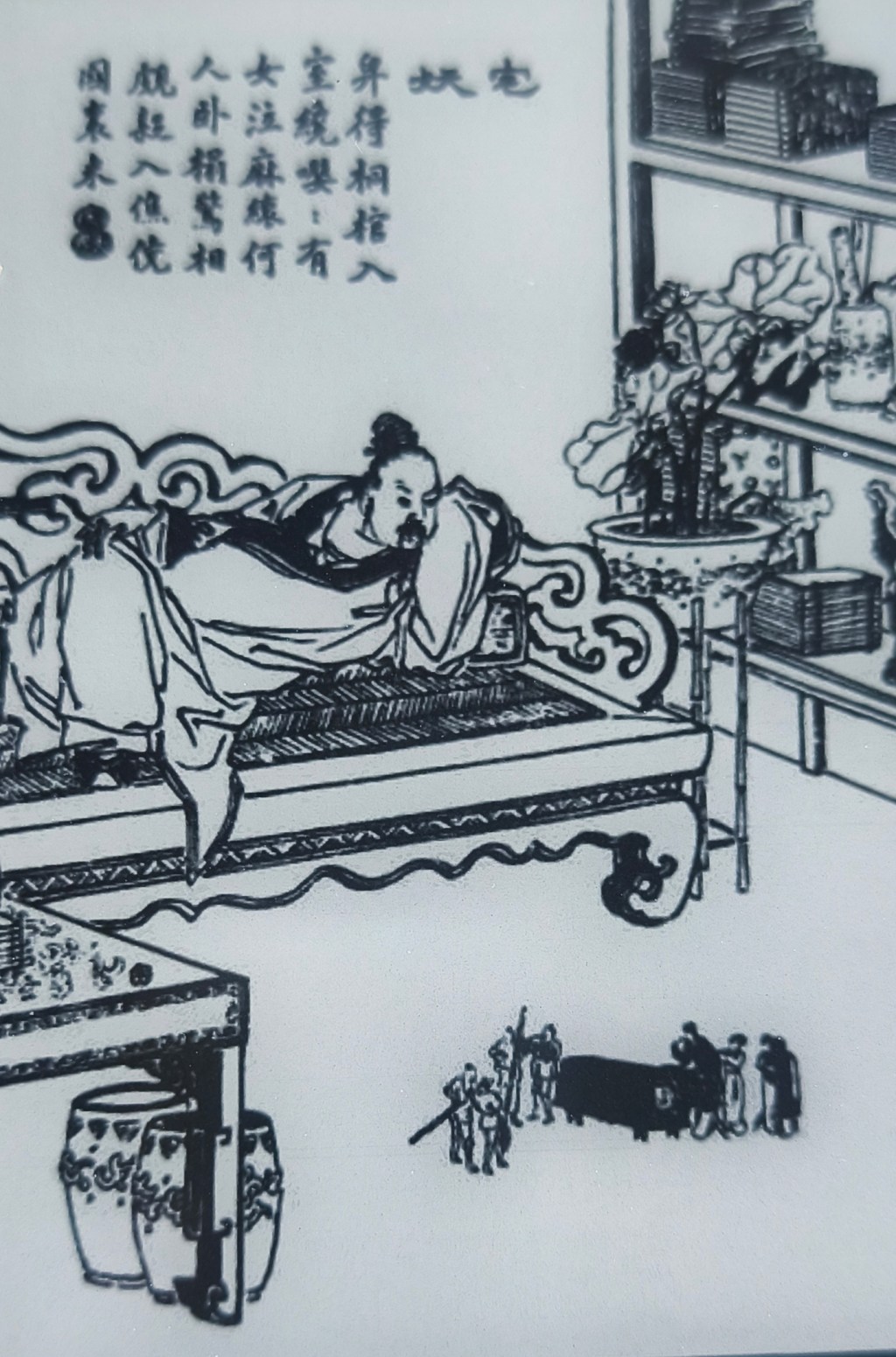
The Haunted House was a curious story: a man owned a strange house. Sometimes, the furniture of a room manifested scary behaviours – its texture felt like flesh, and some pieces could literally slither away.
Towards the end, one of his tenants wakes up to a strange sight: he sees little people in his room. This terrifies him. The story ends with him trying to run out of the room, only to fall flat on his face.
Hearing the commotion, the household runs to his room, but they see nothing out of the ordinary.
One of the most interesting aspects of the narrative style of Strange Tales from a Chinese Studio is that it demands you be comfortable with ambiguity. Readers accustomed to Western storytelling styles, where stories end with some form of closure, would probably feel discombobulated. Like them, I naturally asked, at first, ‘What the heck was the point of this story?’
A story about living under injustice
As I had the conversation with Qwen (the LLM asked me questions, did not feed me answers, and I came to many of the conclusions on my own), I realised that the entire room and house were an allegory for the Qing Dynasty’s justice system and bureaucracy.
The furniture’s texture being like ‘flesh’, and the owner’s disgust after touching it, mirrored the revulsion the author felt towards institutional ‘instruments’ acting in a way that was alien and illogical.
The horrified reaction of the tenant to the tiny, crying figures represented petitioners lost in an inscrutable system; their unexplained grief mirrors how bureaucracy absorbs suffering without redress. The tenant’s terrified reaction probably reflects the scale of the horror this system perpetuates on normal people, and despite his attempts to flee the clutches of this room, he falls on his face. And even when people come to his “rescue” they end up thinking, “what is he on about?” because they don’t see what he sees.
Chinese storytelling traditions
As you can see, Strange Tales from a Chinese Studio demands that you read the stories not at face value, but to see the meanings behind the ‘horror’.
It is written in the style of the zhiguai tradition, where strangeness is documented, not solved. (Ambiguous endings are a feature of the narrative style.) Zhiguai stories are treated like ‘historical documents’; each entry is short, about 500 words.
I also learned that Pu Songling blended zhiguai’s ambiguity with chuanqi’s emotional depth.
According to Qwen/Britannica: “Chuanqi (傳奇, ‘transmissions of the marvelous’) emerged in the Tang Dynasty (618–907 CE) as China’s first mature form of fictional short story in classical Chinese. Unlike zhiguai’s brief, documentary-style records of strangeness, chuanqi developed fuller narratives with psychological depth, character arcs, and often romantic or adventure plots – written with literary elegance rather than historiographic restraint.”
Learning about these narrative traditions was fascinating! However, I lamented to myself that since Western media and storytelling have proliferated throughout the world and become dominant, we are often told what’s the “right” storytelling structure.
The three-part narrative, the “Save the Cat” story structure etc, isn’t universal after all. Doesn’t that mean that those of us reading and writing in English are currently limited to one form of structural storytelling?
Many Western storytellers or writers often tout the ‘right structure’ or a ‘template for storytelling’, and I wonder if we are really losing out on something. Are we being limited in some way, forced to adopt a style – a form of imperialism of storytelling culture?
To this, Qwen, or rather, the Liaozhai (the Chinese name for Strange Tales) professor, reminded me: not all Western traditions demand closure (e.g. Kafka’s unresolved nightmares).
A haunting’s deeper meaning
In the end, The Haunted House’s message is this: ‘The instruments of justice are not behaving as they should.’
Pu was not just telling a ghost story; he was documenting how power feels when it violates its own logic.
During the Qing Dynasty, bureaucracy often felt endless and aimless, and for the people trapped in it, trying to get answers or resolve their grievances, it was an endless room of horrors they could not escape.
The ambiguity of the story is the message.
Fun fact: Some of the tales from Strange Tales have been made into blockbuster movies. Here’s a very popular one: A Chinese Ghost Story, starring Leslie Cheung:


Leave a Reply