After reading Michael Pollan’s brilliant Omnivore’s Dilemma (I interviewed him in 2010 – Make informed choices about food) and Tristram Stuart’s equally amazing Waste: Uncovering the Global Food Scandal, I dreamt of growing and recycling my own food in a sustainable, green-friendly fashion.
However, I lived in a 1000sqf balcony-less apartment in Petaling Jaya, so my dream would have to remain a dream.
But when I came to Adelaide to make my first entry in January last year, I met Yin, a wonderful lady that has helped me so much in settling in my new home. (She was lovely enough to allow me to housesit her home for a week when I was trying to find a place to stay a few weeks ago.)
I was also awed that she grew her own food and recycled her waste to turn into fertiliser!
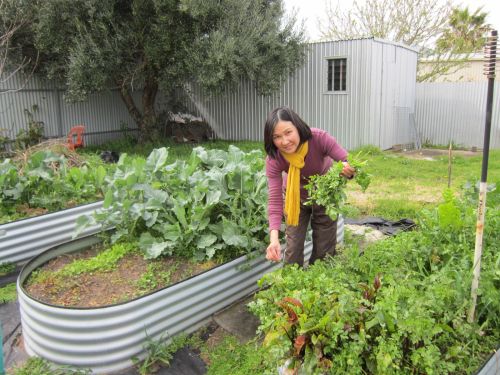
At the back of her house somewhere near Port Adelaide, chard, yummy coriander, chilli, silver beets, beetroot, and spring onion grow side by side. She has olive, lemon and kumquat trees too. Furthermore, her vegetables were huge – they were bursting with health. This, said Yin, is due to her giving them “light” (She’s a Sukyo Mahikari devotee) and talking to them like beloved friends, and the natural fertiliser made from recycled waste foods and “worm juice” produced by the worms in her worm farm she has in the garage.
Yin has been growing her own food for years, back when she lived in Sabah. She said she first got the idea when she met an environmentalist in the Philippines and later, a woman in Japan. She learned the skills she needed to grow a sustainable garden and over the years, even held informal courses to people who wanted to learn how she did this.
Food waste of any kind is collected in a bin outside the kitchen.

Later, she would bury the waste in the ground, with a layer of leaves above it, and “turn it” a few weeks later. The soil would eventually be rich with nutrients and be used for the vegetables.
Alternatively, she sometimes place it in a special bin which does the same job.
She waters the plants, if she can, from rain water collected by two big bins at the garden area.
She would “feed” the worms some leaves sometimes. Later, she would collect the water the worms produce – she dubs it “worm juice” – and waters the plants with it.
Yin’s vegetable garden is really inspiring, and I particularly love the coriander that she grows. It’s plentiful, organic and so yummy!
I’m usually not a camwhore, but I can’t help snapping a photo with the vege bounty. Look at the size of the vegetables!
I really do hope that I can have my own vegetable garden like Yin’s one day. Maybe not one as “full on” as hers, but I hope to eventually grow a few pots of herbs and vegetables: coriander, spring onions, rosemary and thyme would be lovely.
 Elizabeth Tai