I ask: Why not?
It is, after all, a holocaust the world seemed determined to ignore, to brush aside, and till this day, remain ignorant about.
Before I go on, I’d like to emphasise that I’m not aiming to blame or point fingers at Japanese people. After all, one can’t control one’s ancestry. However, I’d like to bring awareness to this massacre, which remains not talked about till this day.
Let’s continue.
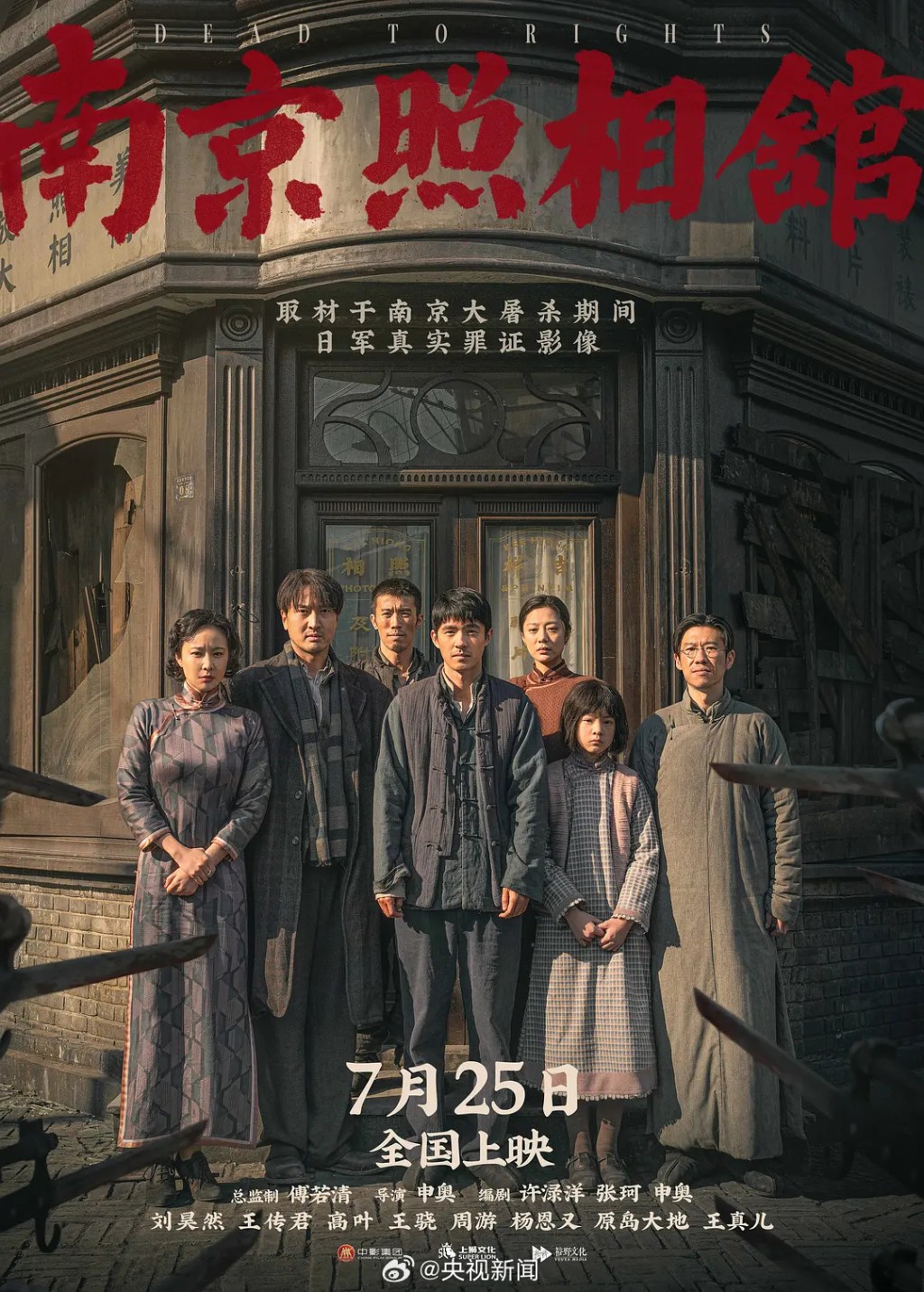
According to Michael Glitz, Dead to Rights is the No.1 movie around the world “by an almost invisible (woman) margin”. This surprised me because I thought that in today’s depressing climate, this movie wouldn’t be that successful.
But perhaps due to the curiosity about China at an all-time high these days, maybe this shouldn’t surprise me.
FYI, the movie is about a group of ordinary people sheltering in a photo studio amid chaos. They are forced to develop film for a Japanese military photographer and inadvertently come into possession of images that can testify to the slaughter.
In China, the film ignites strong emotions across China.
From the article:
Renowned director Feng Xiaoning, speaking in a video circulated widely online, shared his reaction to the film. “When the film ended, the entire audience remained seated, unmoving, until the credits had fully rolled. Everyone was lost in deep thought,” he said. “I believe every Chinese person, and everyone in the world with a conscience, will be shaken by this film.”
Tai Tales is usually a light-hearted affair. I try not to post things that could upset people, but the open wound that is the Nanjing Massacre refuses to close, so here we are, still talking about it.
Sorry, I know, I know! I’m still healing from an abscess, and I can’t help but think about this metaphor as my wound heals. Although the wound is recovering nicely, it’s still “open” and has not closed and can send me uncomfortable zaps of pain as a reminder.
I can’t help but think how this is a perfect metaphor for how the Nanjing Massacre feels to the Chinese not only in China but around the world. An open wound. It may have healed over time, but it will zap us randomly without warning.
So, if you’re up to it, this week I want to highlight some articles highlighting the terrible World War II holocaust that the West has dubbed the “The Rape of Nanking”, made famous by Iris Chang’s book of the same name.
When China Says “Remembering History” About WWII, Is It Calling for Revenge?
URL: https://www.fredgao.com/p/when-china-says-remembering-history
China’s commemoration of World War II and the brutal Nanjing Massacre has attracted critics, who are asking, “Why now?” My question is: “Why not?” Unfortunately, Japan continues to deny its cruel acts in World War II, and this is a raw wound for many Chinese communities around the world, especially in China.
Dead to Rights, the movie, lands around the world
I am still shocked that so many around the world (especially in the West) are not aware of the Nanjing Massacre. Perhaps this movie will finally reverse that. Hopefully. I don’t think anything will change, however.
Dead to Rights is coming to Malaysia around end of August, near Malaysia’s Independence Day, interestingly.
To be very honest, I don’t know if I can watch Dead to Rights. I watched the Christian Bale movie Flowers of War and it left me depressed for nearly a month.
I had to process it, in the end, by writing the short story, Blood of Nanking (you can read it on Substack). Yet, the movie didn’t show the graphic detail of what happened. I don’t know if I’d be able to handle watching a more graphic representation of the massacre, though reviews seem to indicate that they didn’t make it too graphic.
FYI, in South-East Asia, we too suffered the same types of massacres, but not to the extent of Nanjing. For example: The Sook Ching massacre in Singapore, then part of Malaya.
‘We were never friends’: A massacre on the eve of WW2 still haunts China-Japan relations
URL: https://www.bbc.com/news/articles/cp89ed9j5ygo
It is unfortunate, but the Japanese government, and its media continue to downplay or even deny that the Rape of Nanjing ever happened.
However, there are Japanese people who acknowledge this history and urge other Japanese to face “the dark side of their history”.
But he’s more of an exception than the rule. This China Daily column, Japan’s selective amnesia threat to peace and historical truth, said: Instead of prompting a thoughtful reflection, Japanese outlets such as TBS Television linked the movie’s popularity to growing anti-Japanese sentiment in China, while the Yomiuri Shimbun dismissed it as “overhyped political propaganda”. The Sankei Shimbun went further by publishing a column with the headline, “The ‘Nanjing Massacre’, as claimed by China, is a lie”. Even former Japanese national soccer player Keisuke Honda initially dismissed the massacre as a “Chinese-made lie”.
Eye-rollingly, typical of BBC who often ends their articles with “at what price”, hints that the movie is part of some kind of propaganda campaign.
Look, guys. Let the Chinese tell their stories, no matter how ugly, how about that?
“They simply said, let’s forget about that, let’s set that aside. They’ve never dealt with the history – and now the problem has come back to haunt them again.” – Prof He, quoted in the BBC article.
The Light of History Should not be Lit by Hatred
URL: https://ccllss.substack.com/p/the-light-of-history-should-not-be
The writer urges that difficult events in history like the Rape of Nanjing should not be fueled by hatred but by evidence, dignity, honesty, and reflection. Historical cinema should commemorate responsibly, balancing remembrance with restraint, to prevent history from being misused as a tool of hostility.
War subjects carry traumatic images by nature, and the climactic pitch of music and performance can, in certain screenings, ignite a mood of collective catharsis. How to prevent that catharsis from being converted into immediate hostility toward present-day others is the public ethics challenge any historical film must face when it meets an audience.
Still, some are criticising China for “bringing up Nanking” today.
URL: https://substack.com/@chinainsight/note/c-145359160
I thought Amber’s response to this was really good, especially this sentence: “But it’s just as unacceptable when people exploit the tragedy of the victims to make a point about other current affairs. Even though issues like extreme nationalism or China’s social problems do exist, please discuss those in a separate setting instead of exploiting the victims and survivors to fulfill selfish goals.”
As for me, I have always had an uncomfortable reaction to Japan government’s “we didn’t do it, they’re lying” stance about the whole thing.
A few years ago, a group of Japanese Christians visited our church, went on stage, and bowed deeply to us, asking for forgiveness for the crimes of their people against the Chinese (and other races) in Malaysia. I remember watching it, feeling uncomfortable, thinking: “But it’s not really your fault. You shouldn’t be the one apologising! But the ones who did it, the government, are refusing to apologise!”
Postcard From Japan
URL: https://cosymoments.substack.com/p/postcard-from-japan
William Poulos visited many places in Japan, but what caught me about his entry was his reflections when visiting the Yasukuni Shrine, dedicated to soldiers who died during World War II. (This shrine is extremely controversial in China. If a Chinese person is seen visiting it, they could end up cancelled, like once-rising-star Zhang Zhehan who had his career destroyed by an image of him standing in front of the shrine.)
William was amazed by the plaque about the Nanjing Massacre, which was blandly called “The Nanking Campaign”, calling it a “masterpiece of propaganda-by-euphemism”.
Why Did We Forget Japanese War Crimes?
https://kenlacorte.substack.com/p/why-did-we-forget-japanese-war-crimes
They forgot because it was convenient to.
I try not to be too salty about this, but at a time when Gaza is being ignored by some governments are we surprised this happened to China’s holocaust? It wasn’t convenient to acknowledge this at a time when Japan was a strong economic partner to the United States (and the world).
Ken argues that Japanese war crimes during WWII, such as the actions of Unit 731 and the Rape of Nanking, were as horrific as those of the Nazis but are far less remembered. It explores potential reasons for this collective amnesia, including Eurocentrism and Cold War politics that shifted focus away from Japan’s atrocities.
The Rape of Nanking
URL: https://minakohistani.substack.com/p/the-rape-of-nanking
This piece reflects on Iris Chang’s book and the atrocities committed by the Japanese military in 1937, describing the event as a “forgotten Holocaust.” It details the systematic brutality and mass murder in Nanjing and criticizes the inaction of the international community.
The Goddess of Mercy of Nanking
URL: https://grumpychineseguy.substack.com/p/the-goddess-of-mercy-of-nanking-minnie
Read about Minnie Vautrin, an American missionary who saved over 10,000 women and children by turning her college into a sanctuary during the Nanjing Massacre.
The Good Nazi
As much as I whinge about the inaction of the world about massacres and genocides, let’s all remember there are always heroes, even from sides whom we consider “bad”.
John Rabe, a German Nazi, was one of the many good foreigners who rescued the Chinese during the massacre.
There’s a movie about it; it’s in German:
Interestingly, someone made the movie available on Youtube, with English subtitles. Do watch it if you can.
The Chinese also truly honour Rabe, preserving his house in Nanjing as a memorial.
End notes
Some will cry Dead to Rights is Chinese propaganda. (Well, in that case, was Schindler’s List propaganda?) Sure, it’s “inconvenient” for China to talk about this now during heightened tensions around the world, especially since the tarriffs are making things difficult between China and Japan as well. But there’s never a “convenient” time to talk about genocides.
My philosophy about the whole matter is this:
If some powers that be want us to forget that The Rape of Nanjing ever happened, or want us to “let the past remain in the past”, then it’s up to the people of China to continue reminding themselves and the world that this brutality did happen so that history will never ever repeat.
It’s their story. Let them tell it.
Note: Nanjing is the Mandarin pronunciation for the city. 南京 – 南 (Nán), 京 (Jīng) means South Capital. It’s a city in Jiangsu province, China.
Thank you for reading Tai Tales! To receive new posts and support my work, consider becoming a free subscriber.
As I know subscribing to a newsletter can be quite a commitment, you can also give me a tip:
If you liked this issue, it would be great if you could share it with your network. 🙂


Leave a Reply