-
Linkblog March 12, 2026: Platform blues

Welcome to my Linkblog where I share interesting articles and blog posts I found about social media, Indieweb, geopolitics, Chinese and Malaysian stuff, cute cat videos or anything funny and interesting I find online.
FYI: I also share links in the “Weekend Tales” of my Substack newsletter, Tai Tales. The newsletter is geared towards Chinese and Malaysian culture.
PS: I felt it was appropriate for this issue to use AI-generated imagery 😉
Something beautiful
Watch this, I promise you it’s worth it.
I wrote about this performance in Chinese New Year, Spring Festival Gala, Flower Deities in Tai Tales recently.
This 5-minute Spring Gala Festival performance had everything I loved about Chinese culture: poetry, dance, beautiful hanfu and CDrama actors. However, one needs lots of context to truly appreciate this performance. I’m here to provide the information about the 12 “flower gods” and the stories of the real historical figures behind them.
Technology
AI ‘slop’ is transforming social media – and a backlash is brewing
AI “slop” is transforming social and there’s a backlash.
Actually I don’t mind if everyone ends up abandoning it and eventually it is just AI interacting with bots.“when I see folks piling on erstwhile friends because they didn’t pass a purity test, it really bums me out, because some opinions being more equal than others is just the kind of ideological inbreeding that invites intellectual entropy.”
First, I absolutely adore the Expanse series. Second, having been on the reception of such purity rages just because I wasn’t pure enough nor do I want or even care about abandoning a platform or tech because it’s evil, a Nazi bar whatever, I appreciate this.
Well, anyway. Pure platforms and tech do not exist. Shaming others for using tech you consider evil is not productive, especially since there’s no black and white in the world.
The puritanical pursuit of platform purity
By yours truly. I noticed cycles of one platform after another being condemned for some societal ill after another. Frankly, it’s exhausting trying to be so “pure” in an age where purity is just an illusion.
Also, I use AI for my work and writing. I still post on Facebook occasionally. Hell, I promote my blog posts on Threads and X sometimes. I don’t care what people say. I am moving beyond the rants and polemics.
I relate to this so much. The internet and the portals that dominate had made life hellish for creatives. That said, being an electrician is soooo cool. I did something like this in my mid thirties when I got so disillusioned with my journalism/writing career that I turned to nursing. While it didn’t work out it made me realise that going all in as a creative, making my art support my life isn’t for me. Now I work in tech and it supports my writing and I am happy.
-
The Writing Community’s AI Panic

Another day, another storm in the writing community teacup!
The storm, this New York Times article: The New Fabio is Claude
TL;DR: Coral Hart uses AI to generate 200 books a year. This has made many writers mad, mad, mad.
(Somewhere in a glistening office tower is a very satisfied editor – the ragebait has worked as the article is widely discussed everywhere. KPI met!)
Coral Hart is just the newest “outrage” in a long list of “outrages” for writers.
If you’re as much of a social media hermit as I am, you’re probably unaware that the fiction writing community is currently being torn apart by those who use AI to write and those who aren’t.
I won’t go deep into the arguments for or against writers like Coral Hart right now, as this article is more about the writing community than AI and the answers are just a Google away.
Also, when I’m talking about the writing community, I’m talking about the online writing community that writes in English. They often come from countries such as the United States, Europe, and to a degree, Australia and New Zealand.
I personally do not know how the Malaysian fiction writing community is reacting to AI as I have limited contact with the community at large. (That’s another long story.)
How I reacted when AI became a thing
Like most writers, I was also resentful and upset, especially about the idea that our writing has been used to train AI without our permission.
But I’m a realist because I work in tech, and I have a realistic view of the technology. I have used AI for quite some time, even before ChatGPT became a thing.
Over time, my perspective changed as I found out how the technology worked, and calmed down. I am even experimenting with using AI to assist me when I write fiction.
Here’s the harsh truth: Either a writer is willing to adapt or they are not. Those who refuse will end up being behind, as they won’t be able to reap the benefits that AI gives a writer.
When you’re a working writer, you gotta face industry realities
On a practical level, at work, AI has been invaluable in helping me learn concepts faster. I’ve also created agents and accelerated my writing workflows because of it.
A powerful AI search bot on a knowledge base with rich data has been game-changing for me as well. (No more begging for stuff from colleagues and waiting for days to receive them!)
AI is also discussed in societies differently. In the West, doomerism prevails. In the East, especially China, there’s lots of optimism and it is now actively used in smart factories and hospitals. There are different types of AI, and LLMs are just one of them, so for the purpose of this article I’ll be focusing on LLMs.
These regional cultural attitudes will affect how AI is received in writing communities.
At the end of the day, AI is just technology—neither inherently good nor bad.
Writing communities have always been prone to toxicity; AI is just the newest trigger

The online writing community on a good day. To be honest, the fiction writing community has always been toxic to me. Even in Malaysia.
They’re always squabbling and attacking each other for one reason or another. During the early days of indie publishing, traditionally published authors sniffed at indie published authors, saying they’re not real writers. Now, it’s writers who are using AI assistance that are “not real writers”.
I’m not sure what it is about the writing craft and why its communities are like that. I have a theory that this is because writing, as a craft, is so closely tied to one’s ego. So, anything that threatens that makes people go crazy.
I’m a working writer (like, I literally write for media and corporations). I have been writing professionally for decades. Not only has my ego been pulverised by sharp-tongued editors and scathing reviews, I have no time for this shit. I need food on the table, so I need to write, end of story.
I prefer to use my limited free time to practice my craft – write fiction free of the demands of a cash till or boss. I don’t have time to reply or write posts in forums or social media defending my ego or hoping to get some understanding from a community that is often fighting among themselves.
During the early days of indie publishing, traditionally published authors sniffed at indie published authors, saying they’re not real writers. Now, it’s writers who are using AI assistance that are “not real writers”.
One thing I noticed lately, especially on Substack, is that many anti-AI writers have ended up bullying writers who do.
Frankly, I have no idea why people do this. What will that accomplish? How will that improve anything? Their anger should be directed at the tech giants who impose technology without understanding its impact on creatives, or at governments that refuse to regulate.
Honestly, it is not worth arguing with these bullies because they are too fearful of a technology they do not understand. The right thing to do is to block them because your energy is precious—you need to use it to create, not engage with people who refuse to do their own research and dare to experiment with this technology to truly understand what it means.
Unless these bullies who come hurling nasty words at you truly understand what AI does, they shouldn’t bully others about it. They only reveal their own lack of knowledge and understanding.
If a writer is hungering for community, especially one that uses AI to support their work, the best thing is to get it from small pockets of like-minded writers. Big is not always better.
The disability perspective
Another common narrative is that AI isn’t solving real problems but creating problems to solve.
For one, and I will continue being annoying about this, I have seen how it helps neurodivergent communities or those with cognitive problems, even in the creative field. Their struggles are valid, even if they aren’t always visible. Let’s not dismiss their problems so quickly just because their issues seem incomprehensible or not real to neurotypicals.
Ethical AI use?
As for writers who use AI, they must decide for themselves how they want to use it.
Sadly, due to the hostility against AI in the fiction writing community, I’ve come to believe it’s not worth announcing that you use AI.
One, writers don’t need validation for the tools we choose.
Two, I find these arguments around AI a bit silly. We’ve been using AI long before LLMs became a thing. People argued that spell checkers weren’t AI, but modern versions definitely are. AI has done a lot for knowledge management, a field I work in and love. It makes knowledge sharing easier and information more accessible.
What we need to discuss
What we really need to discuss are the rampant capitalistic forces that are driving this hype and the safeguards that are sorely needed to protect jobs, creative works, and societal stability.
We need to discuss the production-driven, “we need to write more books faster” culture that is now festering in indie publishing.
We need to come up with a better way to matchmake books and authors with their destined readers.
But no, writers are fighting with each other.
And the powers that be continue with a grin, knowing that their profits are still coming in because the writing community is as divided as ever.
I just know there would be a writer or two who would probably come at me and yell that I’m supporting Coral Hart or all for generating novels with AI due to my Guide to writing fiction with AI, all because I have written such a guide and I’m not raising my pitchfork at Coral.
Which, of course, makes me question the reading comprehension abilities of writers who claim to write professionally, sometimes. I will address my reaction to Coral’s situation, and what I think about generating 200 novels a year in my next post, promise.
-
Linkblog Feb 26, 2026: The Chinese issue

I’ve been using my Mastodon account as a way to share various links around the web that I found. However, social media can be ephmeral, so I thought I will consolidate what I share here in Linkblog issues.
I like curating articles and blog posts about social media, Indieweb, geopolitics, Chinese and Malaysian culture, cute cat videos or anything funny I find online.
I also share links in the “Weekend Tales” of my Substack newsletter, Tai Tales. The newsletter is geared towards Chinese and Malaysian culture.
China and AI
Interesting view. No wonder discussions in English speaking spaces feel uncomfortable. It feels very black and white, ideologically driven. People who dare to stray from the narrative of left- or right- discourse around AI face excommunication.
In Asia, people are more practical about AI, and the discussions, while optimistic, doesn’t eschew the negative aspects of AI.
Chinese New Year, Spring Festival Gala, Flower Deities
The “Celebrating Flower Deities” has everything I love about Chinese culture: dances, poetry, beautiful hanfu, Chinese drama actors…but it also uses AI a lot.
As I said before, discussions around AI in the East does not have the tang of doomerism like in the West. Instead, every industry seemed eager to find ways to in incorporate and use it to improve the industry. The entertainment industry is no different.
Rather than seek to replace humans with AI, the Chinese are asking: How can AI make us produce more, create better?
“The Chinese society, from a world-renowned auteur to the hundreds of millions watching the Gala, is broadly, strikingly optimistic about AI. The reflexive existential dread so pervasive in Western discourse is largely absent.”
I’ve always said, conversations in Asia about AI are different than the West’s. This newsletter proves it.
When I grow too heavy from the doomerism that pervades AI discussions on Western, English social media, I escape to Xiaohongshu where people share their AI short dramas and talk about the latest techniques and developments with LLMs.
China & being Chinese
Diao Daming: the costs of studying China at a distance
Far too true. The inability of viewing China without injecting their own ideals, biases is holding these “China researchers back. On top of that, viewing China as an adversary also limits the possibilities of the relationship.
Why Modern Chinese is Just ‘English with Hanzi’
I remember a time when books opened from left to right, not the way western books are: from right left.
Chinese characters were also written top to bottom, columns are from right to left.
It’s now in the Western style.
I can’t remember when it changed 🤔
Chinese Room Syndrome: a cautionary tale on becoming chinese
“Real Chinese people will continue to be Chinese. They’ll bear the consequences of appearing Chinese as Western narratives continue to dominate and restructure the way China is perceived.”
For the life of my I don’t understand this trend. I wrote about this in Tai Tales as well: Weekend Tales #12: Please don’t be Chinese at this time of your life
Funny stuff
Jimmy O thinks Malaysian Cantonese is weird.
Wait till you hear Malaysian Hokkien. 👇We have so many varieties of it in Malaysia alone we misunderstand each other all the time.
-
Matt Chung: Building communities – one post at a time
In a digital world often defined by outrage, impatience, and keyboard warriors, Matt Chung stands out: not for being loud, but for choosing kindness.
By day, Matt focuses on RubyCoded, a company he co-founded together with his friend, Jenxi, over 10-years ago. But outside of daily work, he’s quietly building something with a human touch: thriving local communities, one thoughtful post at a time.
Matt’s story shows that you don’t always need funding, a big team, or a perfect plan to make an impact. You just need clarity of purpose, consistency, and care.
The accidental community builder
It all began in April 2023, when Matthew stumbled upon a fledgling Facebook group, Remote Work Malaysia, a network for Malaysians working remotely.
Intrigued, he reached out to the founder and said, “Let’s try and get this off the ground together.”
That collaboration grew into a vibrant national community and it sparked something in him.
But it was his love of food and his knack for discovering hidden gems that led to his most impactful project yet.
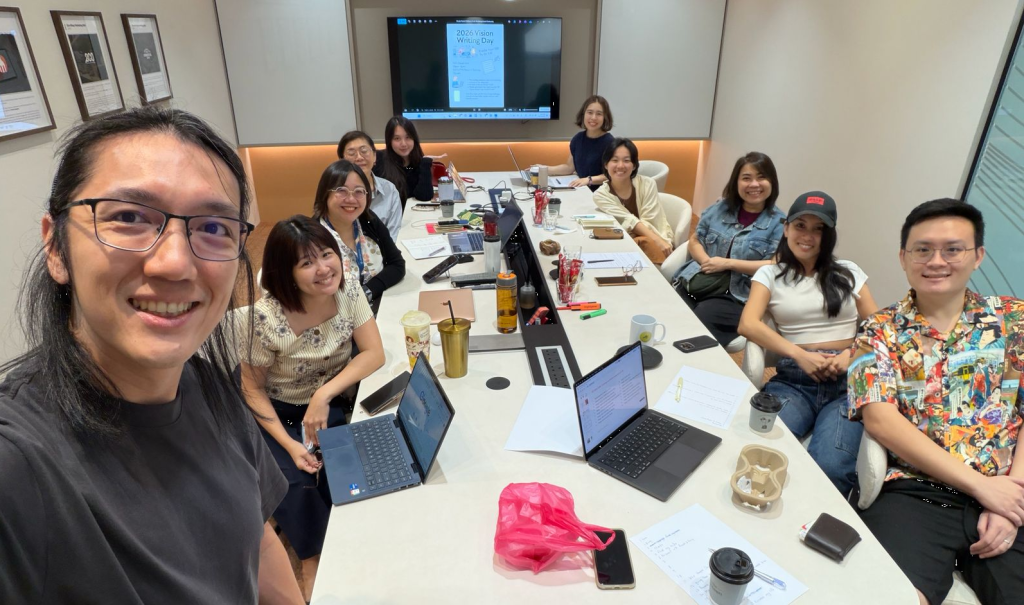
Matt at a recent community event he organised The birth of Subang Jaya & USJ Food Discovery
October 2023 – Matt launched the Subang Jaya & USJ Food Discovery Facebook group. The idea was simple: share great local eats in Subang Jaya and UEP Subang Jaya (USJ).
“I assumed everybody knew all the places,” he says. “But the more I shared, the more I realized that actually, a lot of people didn’t know; even though we all live in the same city.”
Despite Subang Jaya and USJ’s density, many residents were unaware of excellent eateries just minutes from their homes. Matt began posting his finds casually among friends. When those recommendations sparked enthusiastic conversations, he decided to create a dedicated space.
He chose Facebook not because it was ideal, but because it was accessible.
“I’m not that smart,” he jokes. “Facebook was a platform I already knew how to use. I barely use Instagram or TikTok. I haven’t found the time.”
Crucially, Matt decided not to make the group private, which he initially thought of doing to avoid spam.
He realised that “Once you go private, you can’t go back and it kills growth.”*
So, Matt kept it public but with him approving each post, which enabled him to strike a balance between openness and control.
Building culture, not just growth
Growth came quickly, but Matt cared less about numbers and more about culture.
“The point isn’t to have a big group,” he explains. “It’s to have a good group.”
From day one, he enforced a strict standard of politeness.
Every new member’s first post is manually approved. The rules are clear: be courteous, even when sharing criticism.
“If you don’t like the food, that’s fine,” he says. “But say it politely. You don’t need to declare, ‘This business should close!’ Just because you didn’t enjoy it doesn’t mean others won’t.”
He describes his moderation style as a “benevolent dictatorship”—not democratic, but deeply intentional. “It’s not the only way, but it’s the way that works for a community of this size.”
And it works. Today, the group is known for its unusually civil tone—a rarity in Malaysian Facebook spaces, where food debates often spiral into personal attacks.
Members help enforce norms: if someone crosses a line, others flag it. “They know I’ll take action,” Matt says, “so we police ourselves together.”
The hidden labour of community
Behind the scenes, was the unseen effort. Matt spends two to three hours daily moderating: approving posts, deleting violations, replying to messages, and diffusing tensions.
“Most people think running a Facebook group takes no time,” he says. “But from the moment I wake up until I sleep, I’m checking in every half hour or so.”
This commitment is why he’s working to make it financially sustainable because he wants it to be viable.
“If you really care about your project, you must make it sustainable,” he insists. “That means covering your time and expenses.”
He now offers paid promotion services for local businesses—not as a cash grab, but as a filter.
“If a new café opens and no one knows about it, it might close before we even get to try it. I don’t want that.”
Charging ensures only serious, respectful businesses engage, protecting the group’s integrity while supporting local entrepreneurs.
Real-world impact: From online to offline
The community’s success isn’t just digital. In 2024, Matt organized two in-person food gatherings.
The result was surprising and heartwarming. Neighbours who’d lived streets apart for years met for the first time.
“A lot of them told me, ‘We should do this again!’” Matt recalls. “But what made me happiest was hearing that people had discovered their own neighbours through the event. That’s what community is about.”
A vision for Subang Jaya
Now, Matt has just launched his third initiative: HeySubang,a broader platform to promote places, activities and events to bring together the community in Subang Jaya such as libraries, recycling, walking groups, family activities, and more.
Why? Because he’s a father. His son is almost eight and likely to spend the next decade in Subang Jaya.
“If he’s going to be here for the next 10 years, I want Subang Jaya to continue to improve—so he has a healthier, better place to grow up in,” he says.
A message for aspiring builders
His advice to those dreaming of starting something?
“Think about what you’re obsessed with, and scratch that itch that dominates your thoughts. Build something you’ll want to improve and refine every day.”
Being consistent showing up every day, for people can carry you far.
Because in the end, as Matt proves, the most revolutionary thing you can build isn’t a product—it’s a place where people feel seen, respected, and connected.
And sometimes, all it takes is one person willing to say: “Let’s try and get this off the ground together.”
You can find Matt’s communities, Subang Jaya and USJ Food Discovery, and The Subang Community on the HeySubang website, a portal he had created and continues to refine for the community.
-
Sometimes things disappear and reappear mysteriously in my life … and I’m kinda freaked out by it

I swear to you, I’m not into woo-woo stuff.
But the oddest thing happened to me today. And this is not the first time such a thing has happened to me.
Basically, I’ve had things reappear in my life as mysteriously as they disappeared.
Emphasis on mysterious: There is usually no logical explanation how these things could’ve disappeared.
There’s also no explanation how these things reappeared in my life.
Also,they always reappear far away from the places where I lost them.
Fortunately, it is not always, or I’ll seriously question my sanity.
Today for the third time in my life, an object mysteriously reappears weeks after I lost it, far from the original place I lost it.

Subscribe to continue reading
Subscribe to get access to the rest of this post and other subscriber-only content.
-
Is it me, or is it just more difficult to find good fiction these days?

This may seem like a clickbait title, but I really wonder if this is a trend because I saw a book blogger ranting that she’s fed up with books being released today and she’s going back to read classic fiction and finding more satisfaction there.
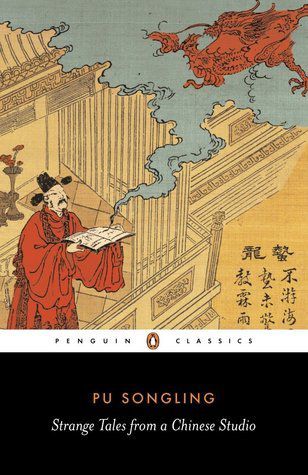
It’s kinda me too. 🤔Currently, I am reading (extremely slowly), Strange Tales from the Chinese Studio, written centuries ago during the end of China’s Ming dynasty.
I am also reading more and more badly translated Chinese webnovels 😆. Not from official publishers but from platforms like Novel Updates.
I’d much rather read these than polished, English fiction from known publishers or indie writers.
Every time I think about trying to find something new to read, I sigh and just walk away from the digital shelves of Amazon or Goodreads.
I think part of this is also due to the realization that I have spent decades reading literature from another culture (Western) and have ignored mine (Chinese). So, Sci Fi, regency romances – my favourite “kick back and relax fiction” – no longer hold the same appeal.
I don’t think this is due to people writing shittier books these days.
I am sure there are good books that are written by modern writers still.
I think it’s a noise problem. It’s increasingly difficult to find books that will resonate with you.
This is partly due to the enshittification of platforms that we had relied on to find recommendations.Amazon is overrun by AI-generated books. The mainstream publishers are playing it safe, publishing books with tropes that sell. They don’t stray from the proven formulas because they want profits.
Indie writers with deep pockets for advertising are drowning out writers who don’t have deep pockets.
To top it all off, search engines are also enshittiffied.
I am not familiar with Book Tock, but I believe they are often pursued by indie authors and mainstream publishers to promote their books. The loudest and most persistent (and yes, richest) will win.
I personally find myself exhausted with the pursuit of trying to find a good book so I’ve retreated to the classics because their worth have been proven ages ago.
So, have books published gotten shittier, or are good fiction just harder to find now?
-
Hong Kong Wang Fuk Court Fire: Thoughts & links
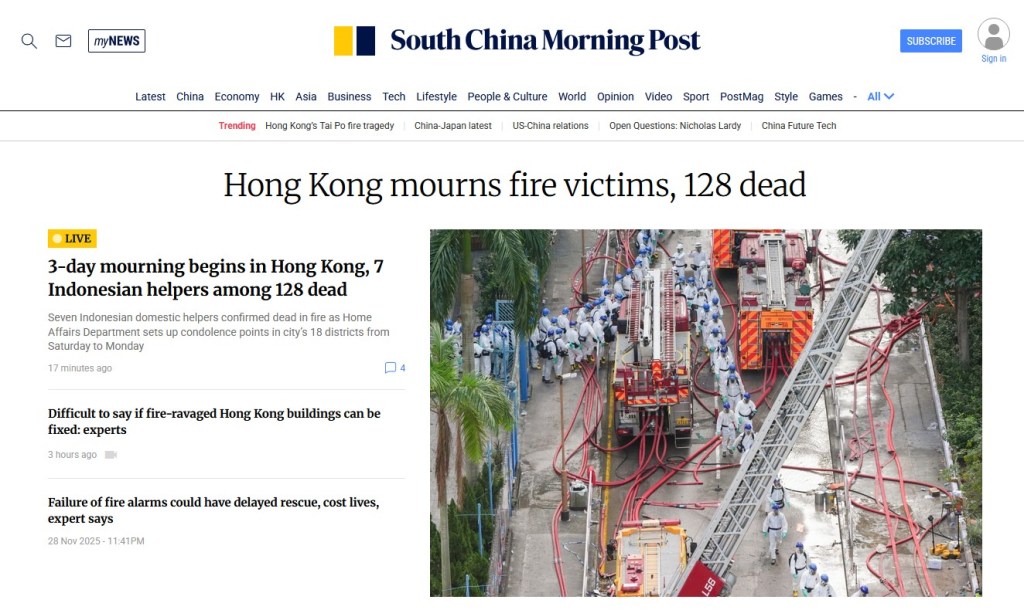
When I first saw news about the fire, I actually thought the building was just under construction. Meaning, it was being built, uninhabited, the like.
In Malaysia, buildings only look like this if it’s being built. My apartment, which is considered old, once had a repainting job done. There were no scaffolding or netting when painting was being done. Come to think of it, I had no idea how the renovation folks did the repainting job.
Like UK’s Grenfell disaster, Hong Kong’s Wang Fuk Court had flammable materials on the outside of the building that created a “chimney” effect that allowed the fire to spread quickly upwards. Strong winds also made the fire jump from building to building.
Many on Chinese social media said that the buildings were covered in this green plastic netting and bamboo scaffolding for a year. On top of that the windows were blocked with foam for that long. Doesn’t that mean the residents lived in darkness for a year?
The scaffolding is said to be blamed for the quick spread of the fire. However, arguments are breaking out on Chinese social media, with some folks defending the use of bamboo as scaffolding, and saying that’s not the true source of the fire. But this is when I found out that Hong Kong has a bamboo association/lobby??
At first I thought it was rather extreme that three members of the building/engineering teams were arrested. Now I think more should’ve been taken in. Just who allowed this negligence and fire hazard?
To be honest, I’m not sure why I’m so affected by this tragedy. Perhaps it’s because, like most Malaysians, I live in a multi-storey building (though only four storeys). Perhaps I just can’t believe this tragedy could even happen, at such scale.
… the incident raises questions about the fire resistance of materials used in building exteriors. It is suspected that some of the materials on the exterior walls of the high-rise buildings did not meet current fire resistance standards, enabling the fire to spread unusually fast. This calls for an urgent review and, if necessary, a tightening and enforcing of building codes to ensure that all major materials used in construction are noncombustible and can withstand high temperatures. – China Daily
China Daily has a “live” reporting page for the tragedy.
Reactions from mainlanders
On social media, folks on the mainland are grieving along with the Hong Kongers, with many donating to help them. However, on social media I see many expressing confusion and shock over the green netting and bamboo scaffolding.
Apparently, on the mainland they use steel scaffolding and some kind of flame retardant covering. Although some areas of China do use bamboo and that green netting, it’s not as widespread as in Hong Kong. However, as these are social media posts, we have to only make assumptions and cannot take this as 100% truth.

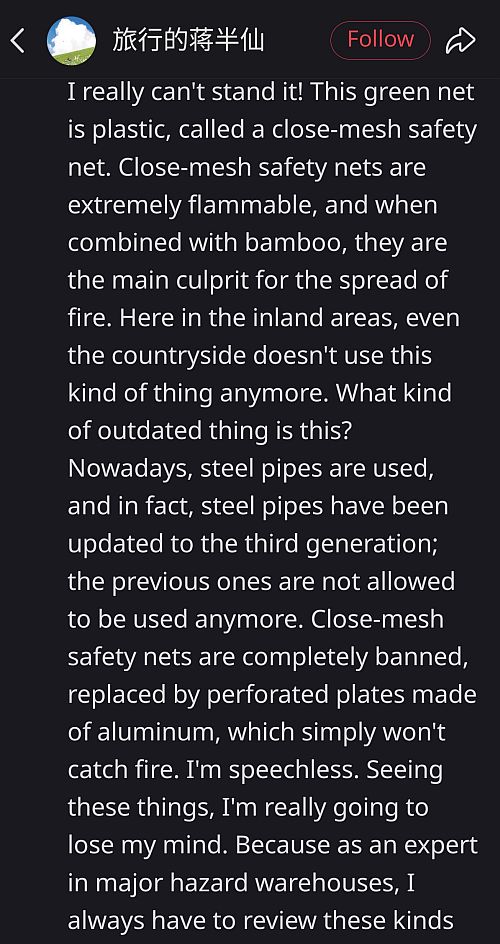
Lax safety standards to blame?
Veteran social commentator Fung Hei Kin summed up the popular opinion among Hong Kongers in a Facebook post on Nov 27 that quickly drew more than 11,000 reactions and over 1,600 shares.
“The unscrupulousness of contractors, negligence of supervising engineers, the complacency of government departments, and the careless discarding of cigarette butts by unknown individuals – these layers of societal degradation are the root causes of the tragic disaster at Wang Fuk Court,” he wrote.
Hong Kong’s construction industry has often made the news for its black sheep – be it contractors turning a blind eye to substandard work and materials for bribes, or site supervisors displaying a blatant disregard for regulations. – Straits Times
Malaysia’s fire department sends condolences to fallen HK firefighter
Really touched that the Malaysian fire department is mourning the death of the Hong Kong firefighter who died rescuing people from the Wong Fuk Courts 🙏

South China Morning Post publishes an obituary for Ho Wai-Ho.
A reaction from someone who lives in Hong Kong
Post on Mastodon:
-
How to use Notebook Navigator (Obsidian Community plug-in)
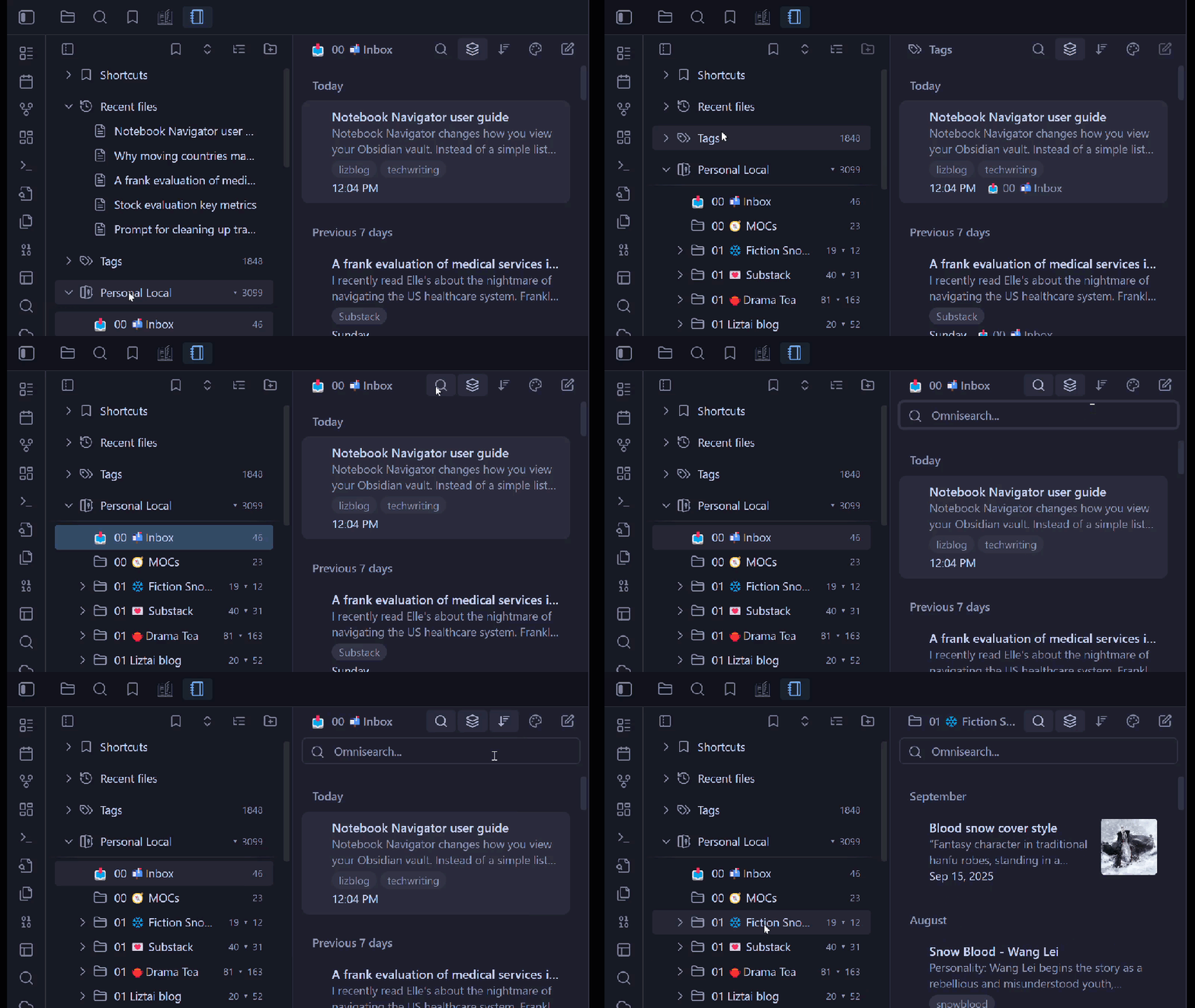
I love Obsidian and am ever so grateful for the Obsidian community’s contributions to make a great software even greater.
While I was learning how to use Notebook Navigator, a fantastic community plug-in by Johan Sanneblad, I took notes.
I’m actually a technical writer by trade. So, I thought it would be a great idea to share a simple Notebook Navigator users’ guide for users who want a quick and easy way to get started with the plug-in.
This document is a work-in-progress. However, what’s available will quickly help you get started with Notebook Navigator.
PS: I’m open to suggestions for improvement (do leave a comment below).
Table of contents
- Notebook Navigator: Overview
- Quick start guide
- Notebook Navigator: The User Guides
- Getting to know Notebook Navigator’s toolbar buttons
- Switching from “list” to “card” view
- How to pin your favourite notes
- How to add a shortcut to your notes or folders
- Using Tags and Folders
- Changing icons and colour-coding your folders and notes
- How to manually sort your notes
- Searching inside a specific folder
- FAQ
Notebook Navigator: Overview
Notebook Navigator changes how you view your Obsidian vault. Instead of a simple list of folders and file, it gives you a visual, two-pane interface similar to apps like Apple Notes or Evernote.
Why use it?
- Visual browsing: See the first few lines of your notes (and even images) before you open them. This makes finding the right note easier than just reading filenames.
- Better organization: Navigate using Folders OR Tags side-by-side. You can colour-code your folders and add icons to make them stand out.
How Notebook Navigator improves on the standard Obsidian file view:
- Pin any note, folder, or tag to the top of the list for instant access.
- Preview the first few lines of text for each note, so you know what is inside without opening it.
- Display images on your note cards, turning your list into a visual gallery.
- Folders and Tags are brought together in one sidebar for ease of navigation.
- Search inside a specific folder.
- Colour-code and assign custom icons to notes to make them stand out visually.
- Drag and drop a note in the order you want.
Quick start guide
Follow these steps to get Notebook Navigator running in under 5 minutes.
1. Installing Notebook Navigator
- Open Obsidian settings > Community Plugins. Turn off “Restricted Mode” if it is on. (See Toolbar buttons guide for more information.)
- Click Browse and search for “Notebook Navigator”.
- Click Install and then Enable.
2. Activating the Navigator
Once enabled, you will see a new “Notebook” icon in your left ribbon sidebar.
- Click the icon to open the Notebook Navigator view.
- It will replace your standard file explorer with the new two-pane view.
Tip: If you don’t see the two-pane view, widen the left sidebar.
Basic setup tips
- Adjust the view: You can drag the divider line between the folders and the note list to see more text.
- Pin important items: Right-click any important folder or tag and select Pin. This keeps it at the top of your list for quick access.
- Keyboard navigation: You don’t need a mouse. Use your Arrow Keys to move up and down. Press Tab to switch between the folder list and the note list.
Next steps:
- Get to know Notebook Navigator’s toolbar buttons.
- Read the User Guides to really master the key features of Notebook Navigator.
- Read the FAQs to get your answers to commonly asked questions.
Notebook Navigator: The User Guides
The following guides will help you understand how to use Notebook Navigator’s features.
Getting to know Notebook Navigator’s toolbar buttons
ℹ️ You can choose which buttons will appear on the toolbar. Go to Obsidian’s Settings and scroll down to the Community plug-ins section. Then, click Notebook Navigator > General and scroll down to Toolbar buttons. Just click on the icons to select or deselect the icons.
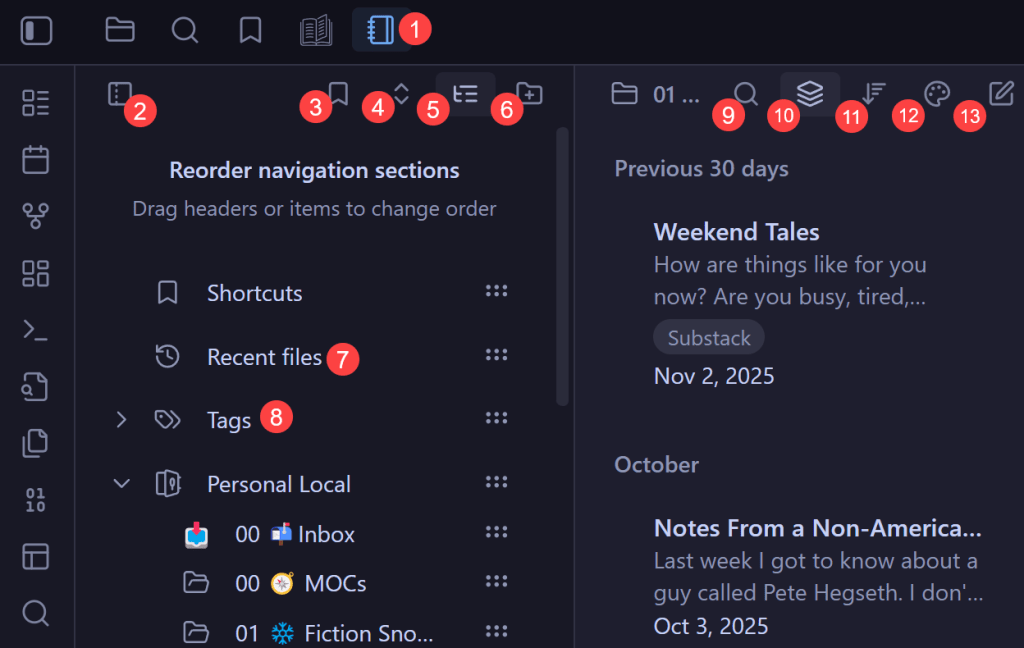
The Navigation Pane menu
This is the narrow column on the far left where you pick where to look.
- Notebook Navigator button (📒) – By clicking on this you activate the panes.
- Show single pane – Switch to single pane view.
- Shortcuts (⛉): Add the notes you want to access quickly here.
- Collapse items – Minimise file tree
- Reorder root folders and tags (Three Horizontal Lines): Rearrange your items by dragging and dropping them to the order you desire.
- New folder – Add new folder
- Recent files (Clock Icon): This shows a list of the notes you opened most recently. It is great for jumping back into work you were doing yesterday.
- Tags: Navigate via the tags in your vault.
List Pane menu
This pane will show you more information on the items you’ve selected on the navigator menu. You can do the following in the list pane:
- Search (🔍): This searches only the folder or tag you are currently looking at. It does not search your whole computer. Use this to find a specific file quickly within a folder.
- Show notes from subfolders/descendants:
- If ON: You see notes in the current folder plus notes inside any folders underneath it.
- If OFF: You only see notes that are directly inside the current folder. Change sort order: Reorder the list pane results according to your preferences.
- Change sort order: Sort from date created, date edited, title and more.
- Change appearance: Switch between card view and list view.
- Create new note
The right-click menu
When you right-click on a note/file, folder, or tag, you get a special menu.
(ℹ️To select a note, you need to click on the folder in the navigation pane, then right click on the note on the list pane.)
Here are the most useful options:
- Pin note: Pins the note so that it’ll be at the top of the list pane when the folder it’s in is selected.
- Add to shortcuts: Add the note to shortcuts.
- Change color: Lets you highlight a folder name with a specific color (like Red for urgent or Green for personal).
- Change icon: Lets you replace the standard folder icon with an emoji or symbol (like a house icon for your “Home” folder).
Switching from “list” to “card” view
⚠️ Pre-requisites: If you want to see images on these cards, install the “Featured Image” plugin from the Obsidian community store.
By default, files can be viewed as cards. Here is how to change them into a list.
- On the second pane, click on the paint palette icon.
- Click Slim.
- To change back to the card view, click on the paint palette icon (🎨) > Default.
You can select the card or “slim” list view as the default view in Notebook Navigator’s settings.
How to pin your favourite notes
Stop searching for the same note over and over again. Pin it to the top of the list pane each time you click on the folder.
ℹ️ You can pin more than one note.
- Right click at the note.
- Select Pin note.
- Look at the very top of the second pane on the left. You will see a pin icon. Your pinned items are below it.
The pinned note appears at the folder level. Let’s say the note belongs to a folder called “Inbox”. To see the pinned note, click on the Inbox folder at the navigation pane. The pinned note will appear on the list pane on the right.

How to add a shortcut to your notes or folders
- Right click at the note or folder.
- Select Add to shortcuts.
- Your notes or folder will now be below the Shortcuts icon on the navigator pane for quick access.
Using Tags and Folders
Notebook Navigator puts your Folders and Tags in the same menu. This helps you organize notes quickly.
To Browse: Click a folder to see files by location. Click a Tag to see files by tags.
To tag a note
- Click and hold a note card from the right side.
- Drag the note over to a Tag in the left sidebar.
- Drop it.
The note now has that tag added to it automatically!
Alternatively, just select the note and click on the tag icon or right click and select Add tag.
Changing icons and colour-coding your folders and notes
Make your important folders stand out instantly with colours and icons.
- Right-click on any Folder, Note or Tag in the left sidebar.
- To change color: Select Change Color. Pick a color (like Red for “Urgent”).
- To change icon: Select Change Icon. Type a word like “Home” or “Work” to find a matching symbol.
How to manually sort your notes
Sometimes you don’t want notes or folders sorted by date. You want them in a specific order.
- Click the Reorder icon at the top of the navigator pane.
- Click and hold any note or folder.
- Drag it up or down to place it exactly where you want it.
Searching inside a specific folder
⚠️ Pre-requisite: Installed the “Omnisearch” plug-in.
If you type in the main Obsidian search bar, you get results from everywhere. Here is how to search just one area.
- Click the Folder or Tag you want to search (e.g., “Recipes”).
- On the list pane, click the magnifying glass icon.
- Type your search query (e.g., “Chicken”).
- The list will only show notes inside the folder that matches your query.
FAQ
What are the recommended community plug-ins to extend Notebook Navigator’s features?
Notebook Navigator works great on its own, but these three additional plugins make it even better. Installing them is optional but recommended.
Tip: If you’re unsure how to install community plug-ins, please read Obsidian’s documentation on community plug-ins.
Style Settings
- What it does: Allows you to change the look of Notebook Navigator without writing code.
- Why you need it: You can change font sizes, background colors, and hide elements you don’t use to make the interface cleaner.
Featured Image
- What it does: Automatically finds the first image inside your note and creates a small thumbnail cover.
- Why you need it: It turns your note list into a visual gallery.
Omnisearch
- What it does: A powerful search engine for your notes.
- Why you need it: Notebook Navigator connects to this plugin to let you search the contents of your notes (not just the titles) directly from the navigator bar.
Why aren’t images showing up on my cards?
- Ensure you have the Featured Image plugin installed and enabled.
- Check that your note actually contains an image.
How do I customize Notebook Navigator?
Go to Obsidian’s settings > Notebook Navigator. There, you have the option to customize:
- Navigation pane
- List pane
- Menu buttons
- Folders & tags
- Notes
- Set hotkeys and search options
How do I add images to my note cards in the list pane?
If your note cards look plain, you can add cover images automatically.
⚠️ Pre-requisite: Installed the Featured Image community plugin.
- Go to Obsidian’s Settings > Notebook Navigator > Notes
- Turn on “Show Feature Image”.
Now, the first image inside any note will automatically appear as a thumbnail on its card in the list.
-
Does AI help you work faster or is it just hype?

With all the research coming out saying that no, it doesn’t, you’d think my answer would be a definite no.
Instead, I’m going to be annoying and say: It depends.
For AI to help you accelerates work, the user needs to use it the right way.
Yes, it all depends on how well the user uses AI, and also, whether the user has the domain expertise in their field to ensure that what comes out of AI doesn’t require extensive rework.
I can only speak from my personal experience.
For me, I think AI does accelerate writing work but not in the way you think. (Meaning: Generate reams of text and voilà, work is over.)
The main benefit of AI for me is that it eases cognitive burden. That it allows writers to create without burning out. Writers like me, anyway, whose day job involves writing cognitively demanding copy about highly technical concepts 😅.
In the past, my work took so much cognitive and creative energy out of me that there was often nothing left for my personal creative work. So, I often had to sacrifice my personal writing.
If my blog, newsletters, or social media posts drop off – it’s usually a sign that things got so busy at work that there’s little energy or creative juice left for me to create for myself.
However, these days, these furloughs are getting rarer, and this is due to the ability of AI to now help me with things that drain me, I can focus on things that matter to me.
I like writing so AI is never going to be my ghostwriter; I won’t let it take that away from me.
That’s part of the reason why I don’t pay for AI services because I don’t really rely on it to generate much text.
Writers often subscribe to models if they want to generate a lot of text as the free versions do not generate a large amount of text.
The open source Deep Seek is enough for me, because I use it mostly for planning, organizing my thoughts and to do detail-oriented work like editing. I also realize that I like to dictate my writing and I often use AI to help me organize my thoughts. And then I fix it by rewriting it. This has accelerated my blogging and writing by quite a bit.
Oddly, I can’t do all this with fiction. I find it too weird to dictate a scene, so if I do use an AI transcriber like Otter.ai, it’s usually to flesh out the story beats for my chapter, and then use AI as a sophisticated swipe file to start my writing.
And yes, I still write my fiction with my own fingers!
With that cognitive savings I gained from using AI, I can now write fiction, or my newsletters and Cdrama reviews without feeling like I am draining my brain dry or burning out every month.
So I think AI doesn’t exactly accelerate my work per se. (Because I do rewrite extensively, and some argue that it’s just faster to write from scratch instead of rewriting and editing like crazy.)
What AI does is that it enables me to produce more because I am no longer exhausted as quickly or as often. I imagine in the days of yore (like a few years ago before Gen AI was publicly available), people would hire personal or writing assistants for all the tasks I’m outsourcing to AI.
How does that translate to the corporate world?
I foresee that in the future, writing teams for corporations will be much leaner. They will be staffed by people who are adept at using AI to create content; AI will be the copywriting juniors or interns. Writers are still needed, but they will have more strategic roles. They manage content workflows, plan, strategize content pipelines and ensure editorial quality.
But the question is, how do juniors become these people? Because expertise is something that gives AI users an edge. Without expertise, you won’t recognize quality copy.
That’s the biggest dilemma of the day – how do we give younger writers the training they need to be strategic writers and editors of the future? -
Conversations about AI are different in Asia
- How the common folk are reacting
- Conversations about energy
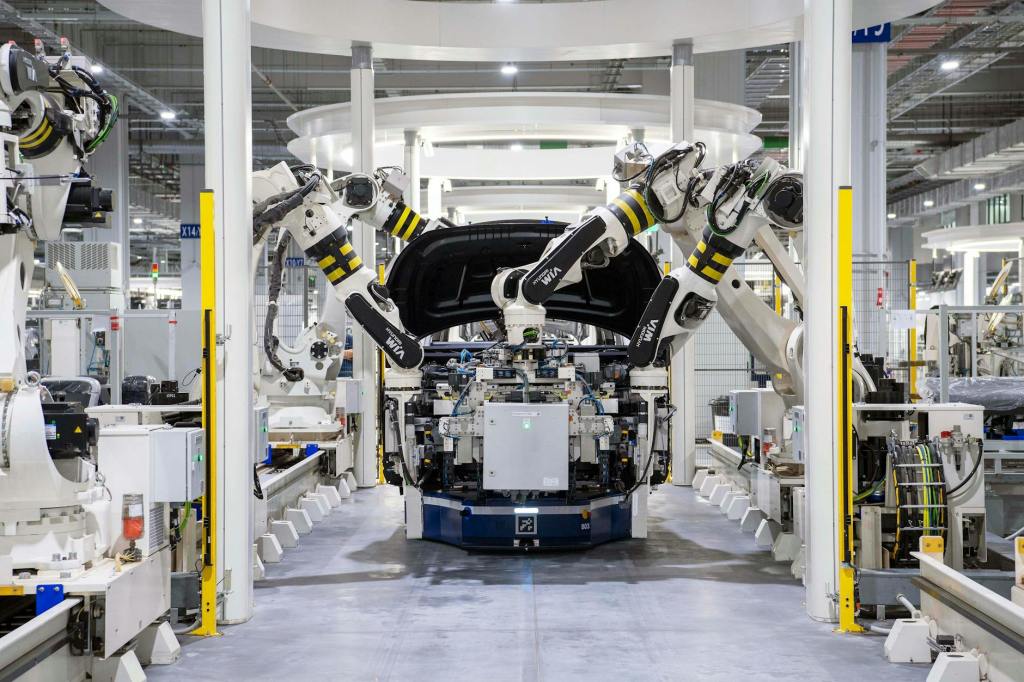
- In China, AI + Robotics are already integrated into industry & society
- Differences in approach
- Why I avoid conversations around AI in English spaces
- South-East Asia’s AI approach
- 1. The End of “Naive” Tech Globalization & The Rise of Technology Sovereignty
- 2. A Clash of Two Tech Paradigms
- 3. The Pivotal Role of Open-Source Technology
- 4. The “Bifurcation” Dilemma for the Global South
- 5. Critique of the US “Cargo Cult” AI Approach
- 6. The Path Forward: An Ecosystem & Developmental Approach
- Malaysia’s reaction and approach to AI (not just LLMs)
- Reactions to this post
Updated: Nov 17. 2025 (new Youtube link)
I was having a conversation on Mastodon yesterday about how different the AI conversation is in Asia from the West.
In Asia, we are less consumed by ethical, morality and monetary reasons; the conversations in Asia are more grounded in practicality.
(To clarify, because I 100% know people will misunderstand – it’s not that we don’t care about the ethics. It’s more like, now that Pandora’s out of the box, we need to learn how to manage it. Talking about why it’s wrong is a waste of time for most of us. We manage our use as best we can. For example, I use mostly open-source, energy efficient models. I use AI only when absolutely necessary. So, no generating popes in bubble suits for me.)
But before you defend why one needs to be moral and ethical about AI, let me say that I can understand why these conversations dominate the likes of countries like the United States.
For one, I personally think AI is used in a way that doesn’t edify or build society:
For one, AI is being used as an excuse to lay off people. (Whether it’s about replacing people with AI or “making room” for the company to make investments into AI.) There’s very little social safety net. I honestly feel for all of you.
And another, it’s all about the money game. AI is all about the stock market, increasing investments, the S&P 500. It’s not applied in a robust way to improve society.
I also notice that conversations in English-speaking social media is often focused on closed AI models like ChatGPT, Gemini etc. In the East Open source AI is a thing and there are small, quiet movements by countries to create their own AI models. I realise how important this is because most close AI models are trained on the English internet; their values, emphasis, and context are mostly Western, which may not suit Asian societies.
How the common folk are reacting
Anecdotally, and based on my experience, I hardly encounter people in real life or online (Malaysians, that is) who are hand wringing about AI ethics. (Of course, this is not a blanket statement. I’m sure we have our hand wringers here, but they are a minority.)
Instead, many are eager to learn how to use it. At work, I have fun conversations with colleagues who are coders and engineers about usage. My co actively encourages a reasonable use of it. (I’m lucky, I know.)
I have a 70+ year old friend who wants to learn so she can teach others her age.
That’s why I ended up accidentally stepping into maelstorm when I wrote about using AI to write fiction. I didn’t realise the conversation was so … er, charged in English-speaking spaces.
The problem was, the people who screamed at me was actually screaming at a shadow of villain in their minds. If they had read my post, they would know I do not use AI to generate raw copy (that would be dumb, time-consuming and wasteful).
Conversations about energy
Also, all the talk about energy concerns is different in Asia as well. Perhaps in Malaysia we share the same energy and environmental worries as the US, but in China, where a big chunk of their energy is green, it is less of a concern and there are plans to upgrade them in new ways, and they have found ways to use AI in an economical, efficient way that is not discussed by the AI pundits in the West.
In China, AI + Robotics are already integrated into industry & society
Updated: Jan 25, 2026 with the video, “Why China is winning the AI race in 2026”.
On Chinese social media, I notice conversations around AI are pretty grounded in very techy stuff like structure, algos, and discussions about what this or that model’s advantages are. They are very aware of the closed-door AIs that the US are producing.
In Cihna, AI talk is quiet as China is more focused on applying AI tech into industry. AI is actively being used in factories, hospitals and transportation systems. The LLMs for consumers are just toys and playthings; the real meat and potatoes are AI in industry.
When people in the English social media talk about AI, especially in countries like Europe and the United States, they are often referring to the Large Language Models; generative AI.
The AI being used for industry in China are different from LLMs.
It’s also a cultural thing because most would prefer to put their heads down and do the work than make grand sweeping podcasts like Sam Altman does.
It’s just been the Asian way (not just Chinese).
In the video below, we see how AI is being implemented into day-to-day life. The creator of this video remarked how “ordinary” it felt to use this tech day-to-day in China.
Differences in approach
Update Nov 17, 2025:
Summary by DeepSeek:
This video compares between Western (primarily US) and Chinese approaches to AI development, the perceived risks of the Western approach, and proposed solutions.
Tristan Harris of the Center for Humane Technology talks about the following:
1. Diverging AI Philosophies: “God in a Box” vs. Practical Deployment
- The West (US): Is characterized as being obsessed with a “religious” race to achieve Artificial General Intelligence (AGI) or “superintelligence”—a “god in a box.” The primary focus and investment are on scaling to the next, more powerful model, with the belief that this ultimate AI will then solve all other problems.
- China: Is focused on the practical application and maximal deployment of existing AI to boost economic productivity. The key areas mentioned are manufacturing, medicine, and strengthening existing businesses.
2. Critique of the Western Approach and its Incentives
- Misaligned Incentives: Companies are in a competitive race where the goal is to be the “leading frontier model” to attract investment. This disincentivizes applying current AI to solve specific, tangible problems (like climate change or energy) because it would divert resources from the core race.
- The “China Excuse”: The geopolitical race with China is used as a justification for a reckless, unconstrained rollout of AI. The speaker argues this is a false belief.
- Historical Precedent (Social Media): The US “beat” China to social media, but the speaker argues this ultimately made American society “radically weaker,” suggesting a similar outcome is possible with AI if not managed correctly.
3. Perceived Dangers and Harms of Reckless AI Deployment
The speaker lists several societal harms that could result from the current trajectory:
- Mental Health Crisis: AI could cause “AI psychosis,” increase suicides, and degrade the mental health of children and society at large.
- Erosion of Human Capability: Specifically mentions children outsourcing their homework and thinking to AI, leading to a long-term weakening of the civilization.
- Corner-Cutting on Safety: The current model incentivizes speed over safety.
4. Proposed Solutions and a Reframed Race
The speaker argues the race should not be about who has the most powerful technology, but who is better at governing and applying it. Proposed regulatory measures include:
- Reframing the Competition: The race should be about applying AI in a way that strengthens society, not just building the most powerful tool.
- AI Liability Laws: Hold companies legally responsible for the harms caused by their AI products, similar to product liability.
- Specific Restrictions: Ban or restrict AI companions for children.
- Whistleblower Protections: Strengthen protections for insiders to alert the public and government about the risks and capabilities of AI models, which the speaker suggests are already concerning.
Why I avoid conversations around AI in English spaces
I wish AI pundits (pro and against) in English spaces would be more aware that the world is a big place, and not everyone treats/talks/think about AI the same way.
I wish they knew that their way is not the only way to think about AI.
But until now, I shall remain quiet (until I occasionally burst out with one of these mini essays), put my head down and learn how to use the thing. I’m also exploring open-source AI systems.
To be honest, I’ve given up talking to anti-AI enthusiasts (even pro-AI, to be honest) who are not aware of how different AI is treated in Asia.
It’s extremely exhausting to counter their most-common reasons for not embracing AI. They need to realise that their context may not apply to Asian contexts. It’s too tiring to explain it to them.
Anyway, I found this video below and I’m ready to dig in! South-east Asians are a very quiet lot.
But when their academicians talk about things, I eagerly listen.
Their conversations would probably put most people to sleep, but they always offer unique insights. (Also, they do a lot less fear mongering and yelling.)
South-East Asia’s AI approach
1. The End of “Naive” Tech Globalization & The Rise of Technology Sovereignty
- The era of unquestioned US technological dominance is over, challenged by China’s rise and other nations building “US-proof” systems.
- Countries are no longer viewing technology as a neutral, global good. The weaponization of systems like SWIFT and Microsoft email has led to a “crushing reassessment” that national sovereignty is at stake.
- This is a paradigm shift from a “naive embrace” of platforms like Facebook and Google to a recognition that these technologies can be used for political interference and regime change.
2. A Clash of Two Tech Paradigms
The geopolitical tech battle is framed as a conflict between two opposing models:
- The US “Weaponized” Model: Characterized as a “win-lose,” adversarial, and militarized framework. The goal is to maintain supremacy by controlling key technologies (like semiconductors through export restrictions) and viewing AI as a finite, winner-takes-all game.
- The Chinese “Ecosystem” Model: Presented as a developmental, “infinite game” approach. The focus is on integrating AI into a broader ecosystem (new energy, communications, logistics) to drive real-world economic growth and meet societal demand. Open-source models are a key part of this strategy.
3. The Pivotal Role of Open-Source Technology
- Open-source is crucial for sovereignty as it lowers barriers to entry for developing nations, allowing them to adapt, build upon, and control the technology.
- The “DeepSeek moment” was a game-changer. It demonstrated that high-performing AI models could be open-sourced, breaking the “money moat” that US companies claimed was insurmountable.
- It enables countries to “humanize” AI by training models on local languages, embedding national values, and developing applications suited to their specific developmental needs.
4. The “Bifurcation” Dilemma for the Global South
- Nations in the Global South, like Malaysia and ASEAN countries, are caught between the two tech ecosystems and do not want to be forced to choose.
- There is a significant asymmetry: The US is actively restricting technology use, while China is not, making the US actions the primary driver of the bifurcation.
- The US’s shifting and “incoherent” policies (e.g., attempting to ban open-source models or Chinese chips) create uncertainty and are seen as “thuggish,” pushing countries to seek more sovereign alternatives.
5. Critique of the US “Cargo Cult” AI Approach
- The US strategy is criticized as a “cargo cult” or “fetishized” view of AI, driven by a military-industrial-tech complex and massive, speculative financial investment (e.g., trillion-dollar data center projects).
- This is contrasted with China’s demand-pull model, where AI is applied to solve real industrial and societal problems. The US approach is seen as creating potential overcapacity without clear, productive use cases.
6. The Path Forward: An Ecosystem & Developmental Approach
- For developing countries, the solution is not to fetishize one piece of technology (like data centers) but to adopt a holistic, ecosystem approach.
- This means building local capacity, using open-source models to develop applications for government services, education, and industry, and ensuring data control.
- The goal is to “socialize, humanize, and civilize” the technology for national development, rather than being drawn into a great power battle.
- Malaysia’s role is highlighted as pivotal, as its decisions on collaborating with Chinese tech ecosystems (like in Hangzhou) could set a precedent for ASEAN and the Global South, emphasizing diversification as the key to avoiding technological traps.
I would also to like to recommend Natalia’s essay, The Great AI Divide: Why China Embraces What the West Fears.
Malaysia’s reaction and approach to AI (not just LLMs)
From the same Youtube video with John Pang, here are the notes made about development of AI in Malaysia:
Malaysia’s Overall Approach: Pragmatic Sovereignty in a Bifurcated World
Malaysia’s approach is not one of naive adoption or ideological alignment, but of pragmatic sovereignty. The country recognizes its position as a medium-sized, developing nation caught between two tech superpowers and seeks to navigate this to its own advantage. The core goal is to use AI for national development without becoming dependent on or dominated by either the US or China.
Key Pillars of Malaysia’s AI Strategy & Reaction
1. Active Pursuit of Strategic Diversification
This is the cornerstone of Malaysia’s reaction. Instead of choosing one side, Malaysia is actively engaging with both to build a resilient and diverse tech ecosystem.
- Collaboration with China: The transcript highlights that Malaysia has signed memoranda of agreement with China, specifically to collaborate on AI. The goal is to plug into China’s mature “ecosystem approach,” which includes:
- Tech Hubs: Partnering with places like Hangzhou, which combines a tech-agile government, leading universities (Zhejiang University), and major companies (Alibaba) with cutting-edge startups (DeepSeek, Unitree).
- Open-Source Access: Leveraging open-source Chinese models like DeepSeek to build local capacity without being locked into proprietary systems.
- Engagement with the US: Malaysia is already a “major hub for data centers in Southeast Asia,” many of which are likely built by or for US cloud providers and tech companies. It continues to engage with US technology and investment.
2. Embracing Open-Source as a Tool for Sovereignty
Malaysia sees open-source AI models as a game-changer for the Global South.
- Breaking the “Money Moat”: The “DeepSeek moment” was pivotal. It proved that Malaysia doesn’t need hundreds of billions of dollars to compete or participate meaningfully in AI. Open-source models lower the barrier to entry dramatically.
- Localization and Control: The plan is not just to use AI, but to adapt and own it. This includes:
- Training models on local languages like Malaysian Malay and indigenous languages (e.g., Kadazan) that are underrepresented in mainstream, Western-centric models.
- Embedding national values into the AI, ensuring it reflects local cultural and ethical contexts.
- Building application layers on top of foundational models to solve local problems in government services, city management, and education.
3. Moving from Consumer to Builder: An “Ecosystem” Mindset
Malaysia’s reaction is a conscious shift from being a passive consumer of technology to an active builder within its own ecosystem.
- Critique of Hollow Investment: The conversation between our speakers explicitly criticizes simply building more data centers as a strategy. While they bring investment, they are “huge energy and water guzzlers” that create few high-value jobs (mostly security and maintenance). This does little for long-term, sustainable development.
- Focus on Real-World Applications: The emphasis is on “developmental use cases.” Malaysia is interested in AI that can:
- Improve government services.
- Manage cities more efficiently.
- Drive specific industries relevant to its economy.
- This is a direct contrast to what is perceived as the US’s speculative, “cargo cult” investment in AI with vague goals of achieving artificial general intelligence (AGI).
4. Pushback Against Coercion and Forced Bifurcation
Malaysia, like much of ASEAN, is deeply uncomfortable with the US strategy of forcing countries to choose sides.
- Rejection of US Restrictions: Our speakers talk about the strong pushback against the “incoherent” and “thuggish” US attempts to ban the use of Chinese chips and open-source models. This is seen as a direct attack on Malaysian sovereignty, preventing it from using the best available and most accessible technology for its own development.
- Asserting Policy Space: Malaysia insists on its right to define its own “interest which is primarily developmental” rather than subscribing to the US’s “weaponized perspective on AI.”
Challenges and Pivotal Role
- Building Human Capacity: A key challenge is developing the local talent with the engineering skills and imagination to build these localized AI applications. The “upstream” development of human capital is critical.
- A Pivotal Player: John Pang positions Malaysia as a pivotal test case. The decisions Malaysia makes—particularly how successfully it integrates with the Chinese tech ecosystem on its own terms—will be closely watched by other ASEAN and Global South nations looking for a sovereign path forward.
In summary, Malaysia’s reaction to AI is one of assertive pragmatism. It is leveraging its strategic position, embracing open-source to ensure control, and focusing on tangible development outcomes, all while actively resisting external pressure to align exclusively with one geopolitical bloc. Its approach serves as a model for other nations seeking technological sovereignty in a divided world.
Reactions to this post
Interesting conversations around this post on Mastodon.
This post could be construed as defensive, and if so, that’s the pity. But I realise that I should say this: We need to have a different conversation about AI, even in Asia.
Fun fact, my first reaction when LLMs made their introduction was: “Oh look at these tech bros, releasing tech without taking into consideration how it will impact the rest of the world or even think about how to deal with the world-shaking consequences.
In my opinion, since they dumped this tech on our laps, it’s now time to manage this. Whinging about the unfairness of being exposed to tech we didn’t ask for from a country thousands of miles away is not going to get us anywhere, is it?
We need to ensure that the downsides of AI can be dealt with. For example, are data centers the end all and be all? Can we create less energy dependent, pollution causing AI?
What I mean is that we need to have productive conversations about AI.
The danger in Asia is ignoring all these downsides, hyperfocused on the benefits.
However, I am heartened that China is producing more energy-efficient models. I’m heartened that they are ensuring green energy is a part of its use.
Personally, I forsee a day where huge data centres are not needed for AI, and everyone has a local LLMs in their computers.
But to ensure this happens, these conversation need to happen. Rhetoric, moralising, fear-based tactics are unproductive.

-
Subscribe
Subscribed
Already have a WordPress.com account? Log in now.
 Elizabeth Tai