-
As a writer, AI has now given me access to services that were too expensive before

One day, when I can pull together some brain cells to form more organized thoughts, I’ll write about how I somehow accidentally became a content engineer and what in the world is it.
Now, we content people have a tendency to give ourselves fancy titles. Sometimes I feel there’s an element of insecurity in there, but my theory is that we are trying to tell recruiters that there are many specialisations in the writing field and there’s no such thing as “a writer that can write everything”.
For example, just because you have been a copywriter for years doesn’t mean you can automatically write UX copy and software documentation. These are specialised fields; the skill required to write both takes time to develop.
But reality, as you know, is different. In Malaysia, especially, companies are keen to hire the “all in one” writer who writes everything. I’ve even been this writer for a company or two.
Although I occasionally whinge about the unfairness of shouldering that kind of burden, I have to admit that having worked that role many times have made me extremely flexible when the AI age came around.
There’s no, “But I’m a [insert specialised title] not a [new thingy].” My attitude is, “Aight, what’s this new thing I have to learn so that I can get on with it?”
So this season, the new thingy is AI, or to be more precise LLMs and generative AI.
Last week I built the editorial planning app of my dreams (okay, it still has a few bugs that need to be ironed out) and a skill that would automatically create PDFs out of Confluence docs. I felt like a superhero at the end of the week. I’ve tried to tweak, bend and stopped short at smashing my Jira subscription to get an editorial planning tool out of it. Last week I gave up and decided to just build something new. The fact that I managed to get a workable app in three days was an absolute miracle to me.
I was thinking to myself that this app wouldn’t have been possible if not for Claude Code (and other AI). Before, the app would’ve probably taken months to launch. The ping-ponging, meetings, chat messages, JIra tickets that would fly back and forth just to communicate the product specs would’ve taken weeks. I don’t even think a company would greenlight such a project because it would take engineers away from precious projects that actually pay the bills.
But I built this app in three days.
THREE DAYS!
So, is AI genuinely useful to me? Oh yes.
Has it made me more productive? Yup. I am now able to do things in a few days when it would’ve taken weeks to do them.
SO, I find it odd and disconcerting to step into a whirlpool of angry words about AI each time I log into social media after experiencing such personal delights.
Generally, I try to stay out of it, and remind myself that these angry people are based in a land where they have very good reasons to be mad at AI and the companies that push it.
However, because of my tendency to process my thoughts by writing, I’ve been writing about AI a lot lately (rather gushily, I have to admit), and I’ve been attracting angry people as a result.
I don’t know most of them, and honestly I have no idea why they are so angry at me, but they probably see me as a symbol of everything wrong in the world today. I guess?
In real life, things couldn’t be more different. I’m surrounded by people who are optimistic and excited about AI. Heck, I have a 75-year-old friend who is running courses teaching seniors how to use AI!
There’s a huge (clumsy) push by my government to make AI a thing and in Asia, people are generally pretty optimistic and interested about AI in general.
Social media is not real life, I tell myself over and over again.
It is true, however, that my writing has changed on this website as a result. I write more about tech, more about AI, but that’s because I work in the tech industry, am surrounded by friends and colleagues who love using AI, am learning mostly AI skills these days. However most of all, I write about AI more because I’m genuinely having fun with it.
Work, and even writing has been more fun with AI. LLMs have enriched my life so much. The dream of just finishing my novels and putting it out there? It has become more possible thanks to the tech I have at hand.
FYI I’ve actually completed three novels, all written before ChatGPT debuted, but couldn’t put it out there because I just lacked the time and money to edit them and give them decent covers. I spent thousands on the first book, and thinking of the effort it would take to do the same for the second and third book just made me wilt. I’ve worked with human editors and graphic designers, and to be honest, I wasn’t super satisfied with the results I got from the money I spent. I have many authors telling me that I didn’t spend enough which is why I got the results I got. Goodness, I don’t have a sugar daddy to fund a book project that most probably would never break even!
Over the years, work got more demanding and my books remained finished unpublished. I actually worry that one day the files are so corrupted that I won’t be able to open them!
I don’t expect to make money from these novels. I want to put them out there because I hate unfinished business. I have books and short stories sitting in my hard drive and that doesn’t sit right with my.
Before, time , money and energy were my barriers to editing and packaging them into a format that the public can consume.
Now, with AI, I can finally do it affordably and decently.
Yes, there will be those who would rudely cancel and tar me with feathers for even using an AI cover or editing it with AI.
But it’s okay, they don’t have to read my novels. In fact, I’ve always been a weird one; I never really cared how many people read my novels or works.
I get the most joy in completing and experiencing the act of creation. Sure, I appreciate praise and feedback for my readers, but my driving force has always been the act of completion and creation.
So, I cannot wait to finally push out my novels. The only thing stopping me now is wondering if I should serialise it first, and not knowing how to do this.
Note: Please be respectful when leaving comments. I am happy to receive comments that are not aligned to my beliefs or thoughts, but I only welcome those that are respectful. My mission is to create a safe space for discourse in my comments section, so I will remove rude and antagonistic comments.
-
A day in a life of the AI-assisted technical content writer
I find it hilarious that when I search for “working writer” on Pexel, they serve me numerous images of serious-looking people with typewriters. Honey, we’ve moved on from that, but I’ll use it because of the romanticism of it all. In truth, I work with two monitors, a mouse and a mechanical keyboard hooked up to a laptop that constantly reminds me of yet another Jira and chat notification. A steady drip of coffee throughout the day is essential for brain power.
First, a caveat: There’s no such thing as a typical work day for me. Some days I go all-in with content creation. Some days are meeting-heavy days. Other days I plan and manage the content pipeline.
The day I’m highlighting is a “content creation” and “content management” day. Here’s how it can go:
9am: I am in the office with a cup of coffee.
From 9 to 5pm I may be doing the following:
- Bob, one of my agents, has a daily brief ready for me in a chat room. The report helps me get caught up as it tells me what’s been happening in chat rooms and emails while I was asleep. I take note of requests and personal DMs. I may have to rejig the quarterly editorial plan if I get an urgent content request.
- After reading the brief, I send an agent to create a fact pack for a project I’ll be writing about. We have a rich, well-maintained knowledge base it can use.
- While my agent is running around, I’m working with my chosen AI coding agent (it could be Antigravity, Claude Code) to discuss the editorial calendar app I’m building with it.
- Once I get the fact pack project, I’ll evaluate the report to see if the project is “ready” to be turned into content.
- If the project is ready, I’ll evaluate every single claim of the report to ensure its accuracy.
- 12pm. I break for lunch
- Then I’ll write the outline for the case story with my brain and fingers because it’s important to encode that information in my head..
- If I feel like it I will ask another agent to expand the outline to the case study format I’ve told it to use.
- Then I will revise that prototype like crazy.
- Once the draft is ready I’ll use another agent who serves as a beta-reader (from the perspective of our target audience), a “third eye” to critique the draft to surface any missing perspectives/points
- I revise again
- Then once I’m satisfied, I launch a copyeditor agent. If I’m fairly confident I just go straight to a proofreading agent.
- The copy is now ready for review. I update the necessary job tickets.
- The day ends with me going for a walk towards the nearby town centre for dinner.
Okay, I wouldn’t call this a typical day. It’s a fairly intense content-creation day. But it’s VERY possible thanks to the AI assistance.
Usually I prefer to do this entire workflow in two days: One day for creation, another day for evaluation and revision. Different days for different brain modes. It’s kinder on the brain.
In a typical company, a team may execute this workflow. Now, I have a whole content team (and even an engineer bot) to help me. What used to take an entire week or more can be condensed into 1-3 days.
I am still the boss and I still write heavily.
You are probably wondering: why not hire people to fill those roles AI is doing?
Yes, ideally it’ll be great to have a team.
But what makes you think every company has the luxury to hire an entire team for content purposes?
In my career, I’ve had roles where I’m the solo tech writer/writer. All-in-one, jack-of-all-trades content roles are common in Malaysia because local companies tend to be very lean.
If you have a human team to support you, all the better!
All stripes of writers, whether they are tech writers, content marketers or managers, whether they have a team or not, can benefit from the assistance of AI, especially if they know how to use them well.
However, this will be a game-changer for that solo, all-in-one content manager and marketer; it’ll enable them to work with support, even if it’s just a bot.
Enterprise content management and creation is very complex, so I cannot say that AI will turn everything into nirvana overnight for content professionals.
Used improperly, it will still be more work than help. And if expectations are unrealistic, content professional will still be burned out by the demands.
But a company that understands the role LLMs play in assisting content creation will really stand to benefit from it.
PS: I always try to offer a more realistic view of the profession, not a rainbows and kittens idea of how it’s like to be a writer in enterprises. You can read more below:
-
Excited and exhausted: My honest take about life as a techwriter in the AI age
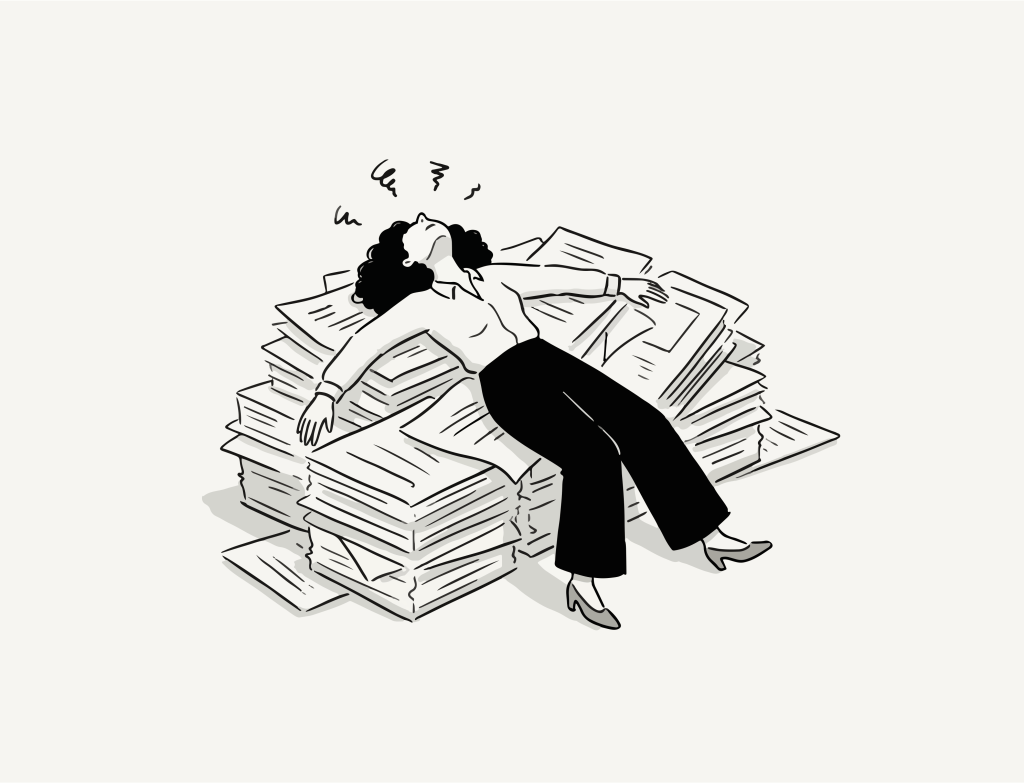
A few weeks ago, I admitted to my online tech writer friend Fabrizio of Passo.uno that I wrote a whiny journal entry about how overwhelmed I was about the amount of things I have to learn about AI.
At the end of the conversation, I asked him to write a blog post about how we technically inclined writers can cope with the speed of change in AI tech and learn fast. He kindly obliged me in a day, writing this fantastic post: Advice for tech writers on a job hunt in the AI age
I love his suggestions, especially #2, which is my favorite way to learn: create your own projects. I found #1 a bit challenging. Books and courses are my go-to way of learning. But it’s true what he said: things are changing so fast now that by the time a book is out, it’s already old news.
How I first reacted to LLMs
Before I talk about how overwhelmed I feel about the amount of learning I had to do, I’ll have to go back to the past a bit.
When AI first landed, and I saw what ChatGPT could do, my heart sank. I knew that the content profession would change yet again. It was particularly discouraging back then because I was just getting my feet steady as a technical writer. Although I was pretty confident my profession would never disappear, I knew that layoffs were coming.
Like most writers then, I was resentful of what Big Tech did with AI. However, I wasn’t exactly upset that they sucked up our work, and trained their AI with it. I was more upset that they did that and then locked the technology derived from our work behind paywalls. If we had a hand in creating the damn tech, we bloody well should have a right to the tech. Worse, since most of these services are denominated in US dollars, this left out a lot of the Global South people who had weaker currencies.
By placing LLM technology behind paywalls, they’re essentially creating an ecosystem of “haves” and “have-nots”. Those who can afford LLM tech (the richer folks) can advance in productivity and skills while the poorer ones are left in the dust.
Fortunately, the DeepSeek moment happened, and now open source LLMs are serious competition to these gated tech services. That’s why I’m pretty grateful to DeepSeek for the movement they sparked. Thanks to open source models, the Global South have a fairer shot at development and modernization now.
Anyway, I digress.
The DeepSeek moment melted away my resentment and I immediately knew that I had to upskill using AI. Fast. Fortunately, I’m a tech nerd who loves playing around with software, and have a natural inclination for learning software. Heck I write technical documentation and blog posts about technological services like app rationalisation, data centre to cloud migrations and stuff. Unfortunately, I cannot say the same for all writers.
A merciless time: Anti-AI writers will be left behind
Writers have not been exactly receptive about AI tech; the creative writing communities are especially virulent about the use of AI in your writing workflows. (Each time I write about using AI in my fiction writing workflows, I inevitably get aggressive hate-filled comments.)
It’s not just about generating copy; some don’t even want you to use AI to edit the copy, which is ironic since tools like Grammarly and ProWritingAid have been using it pretty actively.
For those of us working in the professional content space, we don’t have the luxury to ignore AI or write Substack essays about why we hate it. It’s either learn the skills or have someone who knows AI skills replace you. It’s just the reality in the corporate world now.
I’ve been a professional writer since the 1990s when I was stringing for the national newspaper and writing ad copy for advertising agencies, “faxing” it to them via a clunky, beeping fax modem.
After being a journalist from 2000-2018 (with a break of a few years in between when I had fantasies of being a nurse), I transitioned to the corporate world, working in corporate and government communications and then finally in the tech world where I’ve honed my skills as a technical communicator.
Having lived through the journalism profession’s collapse thanks to the Internet, this is not my first rodeo with technology decimating my profession. When AI emerged with ChatGPT I sighed wearily knowing that I will have to go through a rough transition yet again.
AI has evolved so much and so quickly beyond ChatGPT’s debut in 2022. Now, it’s not about writing the best prompts anymore. Sure it’s still important, but we’ve entered the agentic era where the “AI native” is an orchestrator of agents. Meaning, people are now increasingly managers of “talent”. However, instead of a team of people beneath you, you now manage a team of AI agents. Your work is as good as the AI agents you build.
Many writers in the creative field—the novelists, the ones hoping for a traditional publishing deal—are still stuck with the notion that AI is a chatbot and people use it to generate whole novels with a click. They don’t realize that AI has moved on beyond that. Instead they are picking fights with writers who are trying to learn to improve their workflows with AI.
Yes, I’m annoyed by them, but I also grieve for them. I 100% understand why they are behaving this way. But taking out your anger and frustrations at fellow writers isn’t productive. They spend all that energy trying to bring other writers down when they could be learning from them instead.
They don’t realize how much they’re being left behind. Instead of spending their time and energy fighting writers who use AI in their workflows, they truly need to learn the tech because there’s an overwhelming amount to learn. The writers who are ahead of them in using the tech are freely sharing their knowledge online. They could learn from them instead of insulting them in the comments section.
I suppose the only saving grace for these writers is that most are not corporate writers but write fiction etc. So, the consequences would not be as severe for their career growth. I hope.
This season, the new skill professional content folks like me have to learn is context engineering and content engineering. As our bosses learn about what AI can do, the pressure flows downwards to us content professionals to execute their vision. Sometimes their vision is limited by the technology (meaning, we’re often not there yet), sometimes – and this is a danger to content professionals – it’s limited by the speed we can learn.
And here’s the thing, not every writer out there can learn AI tech easily.
I’ve spoken to some writers and they blank out the moment I say things like “instance” and “markdown”. For one, I’m still trying to convince most of them to have their own websites, but many reply that they prefer to use Facebook because it’s easier. So, what more using LLMs to increase their productivity?
Learning fast, learning messily
When I got over my resentment of LLMs, I had quickly started experimenting with the tools and learning the concepts. First with chatbots, then with IDEs and coding agents. I started keeping a prompt library, then building AI workflows, continuing tweaking them when they turned out disastrous output. I looked for use cases from those generous enough to document them online and tried to replicate what they did.
There was no teacher, no guide. I only had my learning abilities to help me. Fortunately, having transitioned from journalism to content strategy and then technical writing and UX copywriting with YouTube videos, blog posts, books and quick-and-dirty experiments, I’ve had a lot of practice.
The fortunate thing about our age is that free content is everywhere. Yes, some content creators will tease you that they will teach you everything about AI only to gate their most important resource behind a $1000 course. Fortunately, we have many who are willingly putting out content that could power a course freely on YouTube and in their blogs. If you’re good with research, you can dig out many free resources on the Internet. On top of that, Big Tech, eager for more people to use their tools, are putting out valuable courses – often free. Take them.
So, that’s how I’ve been learning. From content creators on YouTube or blog spaces, from Google and Anthropic courses. By running clumsy experiments.
However, lately, all this seems not enough.
Perhaps it’s due to my flagging energy levels due to a health issues a few months ago. Perhaps it’s due to absorbing and being exposed to the hate, vitriol and blather from the fellow writers in the writing world as I try to learn and document my journey. Perhaps it’s an accumulation of all this and managing the increasing expectations that I can 10x my personal or work content workflows. (It’s still unrealistic; people need to understand how much human involvement is crucial in content creation. “Human taste” is hard to quantify or replicate with AI.)
The truth is, I’m tired, I need a break, but the AI companies are not giving me one and neither is the industry, whose expectations of its workers are rising by the day.
So, yes, when I had that conversation with Fabrizio, I was burned out having to juggle all of this. Fabrizio wanted me to turn my whiny journal entry into a blog post, and I told him I definitely would but I wanted to sit with it so that the blog post won’t turn out to be a mere rant and my version of old content writer yelling at the clouds.
I wanted this post to be a letter of sorts to my fellow professional writers out there – I see you, I get what you’re going through. It’s bloody tough, but somehow we will get through this. I will try to help as best as I can.
As for me, I don’t want to just continue the way I am at hyperspeeds, burning myself out. What I need is a better learning strategy and a better way to manage the stress levels.
My realization: Learning needs to be more focused and deliberate
A while back I read a story about this software engineer who told his wife that he needed her to take care of the kids and do the homework more so that he can focus on being an AI native in his tech company.
In an industry where software engineers are being laid off almost every day, I can almost hear the desperation in his voice even if the feminist in me wants to throw up in the corner at the sacrifice he’s asking of his wife.
So, right after he came back from work, he would spend hours at night studying and running projects with AI.
Fortunately, he managed to become one of the few AI natives in his company. Whether he has gone back to doing his share of childcare is debatable, however.
Unfortunately for me, I do not have a hubby to ask this favour, so I have to make do.
But, it got me thinking – what am I wasting time on that I could use to learn the skills I need to be AI native?
Unlike SWEs, I don’t have the technological foundation in programming to give me a leg up. So, my learning curve is much higher. On top of that, most of the videos and resources about AI are targeted at software engineering. This meant that I needed to be more focused and deliberate in my learning.
One thing for sure, is that I need to be stricter with my consumption of information. What’s the point of listening to an hour of an Ed Zitron anti-AI podcast if all it does is annoy and amuse me? Do I really need to listen to YouTubers and podcasters who constantly hype up or rant about the newest AI models (especially since it does nothing for writing), latest controversy/scandal or Big Tech “sin”?
So I need to trim out this unhelpful (albeit extremely entertaining) content, because that hour of listening could be used to learn the latest skill.
Another thing: I’ve been learning “between the cracks of life”. For example, watching a YouTube video while on the train, while wolfing down lunch or as I nod off to sleep.
As a result, I’ve not systematically documented what I’ve learned nor do I have a proper strategy in studying or retaining what I learned. Which means constantly forgetting what I’ve learned and losing precious resources. So, that meant a) scheduling deliberate blocks of time to learn, perhaps during the weekends b) a systematic way of documenting what I learned.
There’s also the added layer of “advertising” yourself as an AI native. Sure, you can build agentic workflows for content, but do people know about it? Writers are often icky about self promotion, but in our age I think it’s not just smart but unavoidable. The loudest gets noticed. The loudest gets the jobs.
It’s a LOT.
If SWEs are overwhelmed, imagine us content professionals whose resources are thin and often gated behind expensive courses.
My next action steps:
- Stop consuming unhelpful (and toxic) content about AI.
- Schedule a block of time during the weekend to learn a specific skill.
- Document what I learn in Obsidian.
- Build more AI projects.
- Learn in public by teaching others what I’ve learned. (It’s the best way to bake the learning in your brain, and it’s a way of giving back to the community.)
- Start owning the content engineer label because by golly I’m already doing the work of a semi-AI engineer might as well call myself.
If you’re a content professional, how are you managing your work and upskilling efforts in the age of AI?
-
My article was No.1 on Hacker News
A couple of weeks ago, Fabrizio of Passo.uno dropped me a message on LinkedIn and told me that my article, “Substack writers, you need a website!“, was No.2 on Hacker News. I thought he was pulling my leg.
I checked Hacker News and indeed it was true: My essay was on the front page. By the time I checked, it had dropped to No.6, but I visited hnrankings.info to check the historical movement of the essay and saw that I was actually No.1 for a brief period.
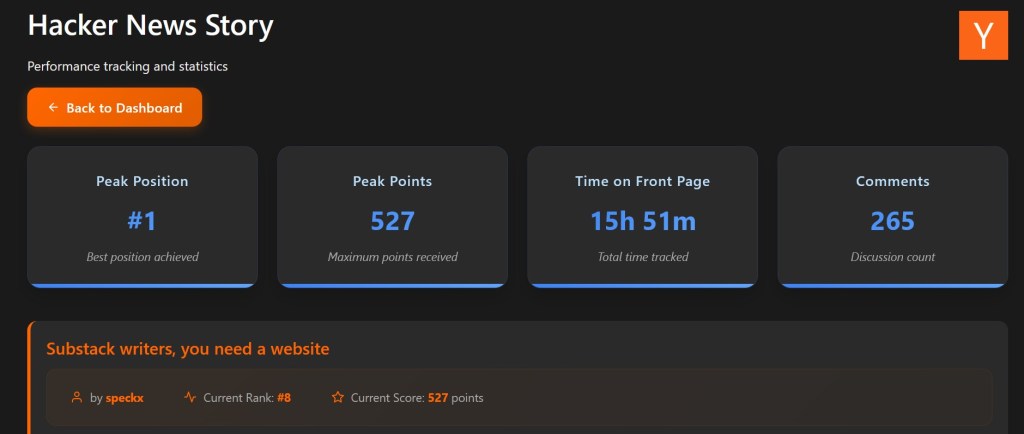
I was absolutely stunned.
For one, although I do write about technical issues as a technical content writer and as a personal hobby, I am not technical-technical, if you know what I mean. Hacker News, the digital rag of SWEs around the world, highlights essays that I sometimes can barely comprehend. So, to be No.1 on that website is something I don’t even dream about.
It’s also a bit ironic, because the content of the blog post itself kind of proved my point. Before Hacker News picked up my post, it was actually selected by WordPress.com to be placed on the front page of its Freshly Pressed page. That was already a big deal for me.
When WordPress.com decided to highlight my post, I didn’t realize it. One day I just randomly noticed that the post was getting way more comments than I was used to. Usually I get about five or six comments at most, but on that day I discovered I had 50 comments. I thought maybe it was a fluke, or that somehow the topic had just resonated with people. Then I saw an email from WordPress.com telling me that I was selected to be featured on their Freshly Pressed page. I got a lot of eyeballs due to that, which was great and made me pretty happy.
I firmly believe it is because of what WordPress did that I got noticed by the person who shared my article on Hacker News.
This would not have happened if I had published the post on Substack. For one, Substack tends to promote its superstars (i.e. those with a lot of subscribers, paid, preferably, and often not from my part of the world. Ahem.) Also, I doubt it’ll promote a post urging writers not to use Substack as their digital homes!
Still, it proves my point that promotional channels are equally important. If not for WordPress’s Discover page and Hacker News, I probably would not have been noticed at all.
Curiously, my Substack post highlighting the essay, Writers, don’t make Substack your digital home! is getting an uptick of comments lately. 32 comments so far! Highly unusual as I usually get less than a dozen comments, and usually from my usual readers. (FYI, I usually offer a bite-sized, behind-the-scenes version of the essay on my Substack, and invite readers to read the full essay.)
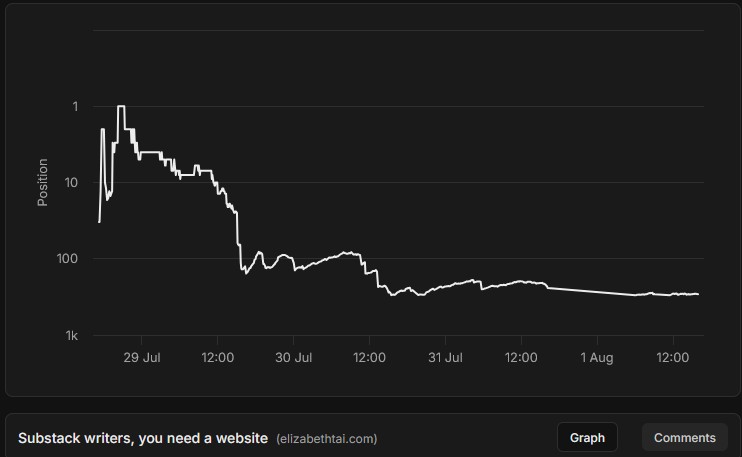
I think my essay coincided with a zeitgeist moment. I happened to write about Substack days before they rolled out their new Pangram AI detection feature.
People were already fed up about the state of platforms in general – what Cory Doctorow famously calls enshittification. Pangram was an “I’ve had it” moment for many Substackers already weary of being tossed around by lack of moderation, algorithms, rules and now a feature that may subject them to witch hunts. Pangram was the last straw.
Why writers need a website they own
My article, “Substack writers, you need a website!” was something I wrote out of frustration from what I’ve been seeing.
A lot of Substack writers are far too dependent on the platform to house their content. As the platform introduces more and more features they don’t like, many are complaining on the feed.
My frustration is borne out of the fact that many don’t seem to be aware that they can escape this “loop of doom,” so to speak. They don’t have to be trapped in this situation nor do they need to treat the platform as an be-all and end-all.
I also noticed that a lot of writers seem to think they can only choose between having their own website or being on Substack. The truth is, writers need to have a digital home that they own, and digital home means owning a domain name. It doesn’t matter what you build your site on—whether it’s WordPress, Ghost, or even Substack, really—as long as you have the domain name, you own the content. It’s like an address you keep forever.
However, if you don’t have a domain and your content lives on something like xx.substack.com or xx.wordpress.com, then the domain authority or “SEO juice” doesn’t belong to you. It belongs to those platforms. That’s why I’ve always championed the fact that you need to have your own website.
But a lot of writers I speak to are reluctant to do that, mostly because they are not technically inclined and feel overwhelmed by the thought of creating their own site. Perhaps it was incredibly hard to create a website in the 1990s, but it’s really much easier right now. There are so many services out there that can help you build your website without a speck of coding on your part. Heck, you can even vibe code a simple static website with ChatGPT if you want.
I realise I’m talking from the point of view of a technically inclined person. I work in tech, use software that would probably make most writers cross-eyed, and even build AI workflows in my company. But I’m telling you, it is not as difficult as you think.
For example, many would probably blink at my choice of hosting my website on WordPress.com. Although I have the technical skills to create my own static website—and did indeed build one at one point—I prefer to have other people manage it for me so that I can concentrate on writing. I chose WordPress.com because it’s one of the most common content management systems (CMS) on the internet. If WordPress.com doesn’t work out, I can easily port my website to another provider.
One day in the future, perhaps when I’m retired (because right now I’m too busy to even think about it), I hope to build my own static website so that my content is in Markdown first and then ported to the internet. But right now, the thought of doing that makes me tired because I have literally thousands of articles on my website. I’ve been publishing on elizabeththai.com since 2012 and have never really stopped, so it’s almost a 15-year footprint to port over. It’s not something you do lightly.
P.S. I have actually managed a few content migrations from one CMS to another for companies I’ve worked for, and I can tell you that each of them made me sweat bricks because they’re often not compatible. And even if they have an exporter feature, you’d have to clean up bugs and mangled content. If I were to migrate my own site, I would probably get professional help because there are far too many things that can go wrong in the process.
Still, some writers are not entirely convinced they need a website.
Many tell me they use Substack because they don’t get traffic to their own websites. Sure, that’s 100% true. Putting up a website doesn’t mean you’ll automatically get more traffic. In fact, it’ll often be the opposite due to the way the Internet is right now with SEO, and worsened by the fact that AI is now bypassing search engines by recommending websites instead. (Right now, corporations are having a headache trying to ensure their content gets recommended by the “answer engines”.)
I don’t get much traffic to my website most of the time (proof below); I’ll be surprised if I get a few hundred views a month. Perhaps I’m weird, but I do not care about traffic nor do I care how many subscribers I have. I care about my content having a home. I care about my content having an address that I own—meaning my own domain.
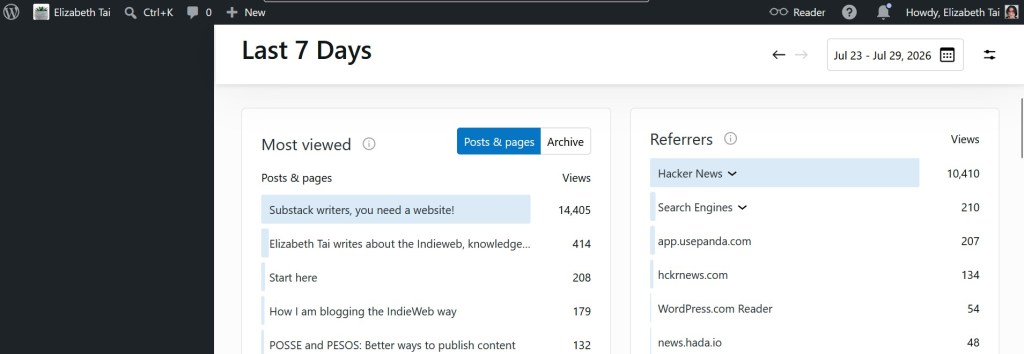
As you can see, my posts usually only get a few hundred views at best. So, the key for writers is to stop focusing on subscriber count or traffic. Focus instead on quality readers and engagement. Do your subscribers engage with your content? Leave comments? If you have only 100 subscribers but 30% of them talk to you via comments or social media, that’s far more valuable than having 100000 subscribers and no one bothers to engage with your content.
And whether your content goes viral and reaches tens of thousands of readers or not, don’t you want that traffic to go back to your website where people can discover your other content?
Having a digital home means that when one of your posts does go viral (whether recommended by sites like Hacker News or a Claude chatbot), people can find the rest of your work. Maybe they’ll even become a loyal subscriber.
In that essay, I pointed out that writers like John Scalzi have been blogging since the dawn of the internet. His digital footprint is massive, spanning decades. He has stated that his website will always be his home; while Twitter shuts down or other platforms fall, his website will always be there because he owns it. I want this for all writers.
It is pretty cool to have reached number one on Hacker News, but I fully expect my traffic to literally tank after this. Being viral is not eternal. I don’t chase clout, nor do I chase traffic or subscribers. What I value most is having a home that I can control, and that to me is far more valuable than anything else. I hope this is the lesson I can transmit to every writer debating whether they need to have a website.
Still, having my essay be No.1 on Hacker News is a feather in my cap, and as a writer I feel incredibly proud that my article has helped people think, debate and judging from the comments beneath the Hacker News post, quarrel (lol).
If you’re a writer on the fence, I hope that you will build your own digital home in the future. It’s one of the best ways to secure your content legacy.
-
How to Build Your Own AI Writing Pipeline (No Paid Tools)
Reblogging this because it’s fascinating to see how this can be done. I probably personally won’t use it for my own personal workflows, as I prefer to be present during the formation of the draft, but I’m thinking of creating a system where, once I complete the draft it gets automatically proofread and parked in a folder where I can upload it to WordPress for publication.

Learn to build a multi-stage AI writing system with free tools (Google Sheets, Apps Script, Gemini API). Get consistent, voice-preserved essays—no paid subscriptions. Step-by-step setup + GitHub repo.
How to Build Your Own AI Writing Pipeline (No Paid Tools) -
Being a minority on social media sucks sometimes
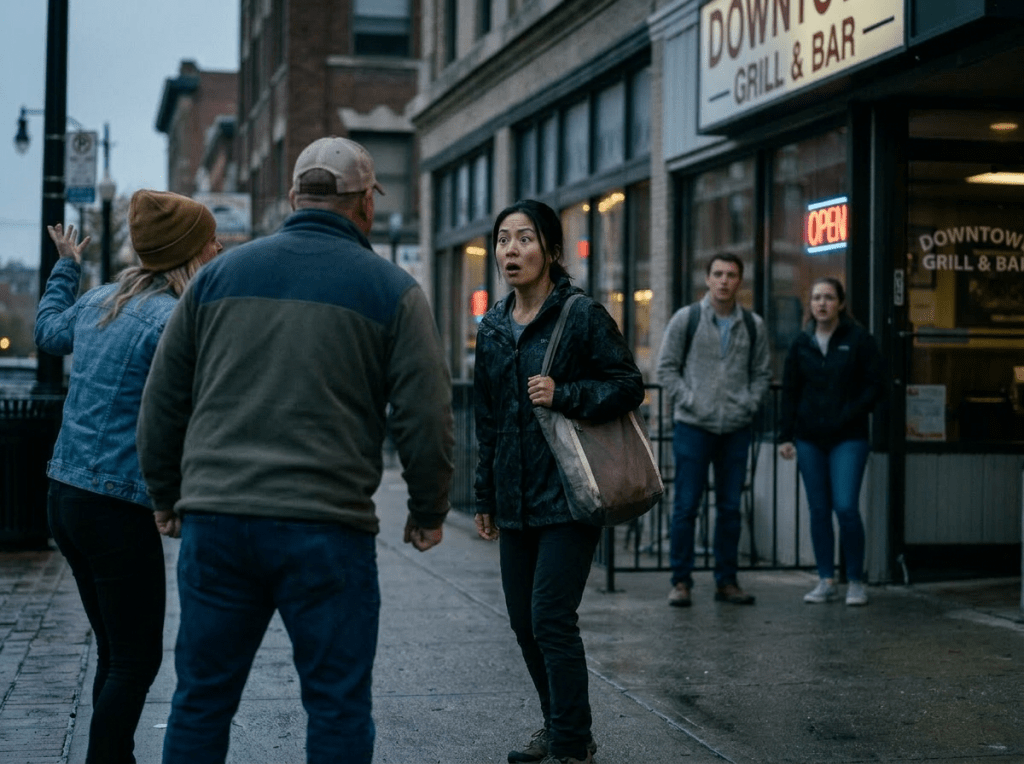
A few years ago, a Malaysian friend told me during the Twitter meltdown that she’s carefully cultivated a Malaysian safe bubble for herself on Twitter and she’s leery of losing that.
Back then, I wasn’t very active on social media; I hung out mostly to drop brief comments on Twitter to people who talk about personal finance. I generally avoid the gurus and their acolytes. So, I thought it was a strange thing to willingly ensconce yourself in an information/conversation bubble.
I GET IT NOW.
After getting on Mastodon, I got super excited but quickly discovered how censorious some of its citizens can be.
a) If you support a narrative on a subject that the majority of Mastodon doesn’t, you will probably be cancelled.
b) You need to constantly be aware of the cultural triggers of the majority on various topics, especially writing, AI and certain countries they do not like. If you happen to not know woe betide unto you if you say something not accepted by the majority.
The urge to self censor and speak up in rebellion
When I wrote the post, What if using AI to write fiction isn’t an evil act? the insults I got stunned me. I was so ensconced in my AI positive/neutral real world that I don’t even realise how angry and unreasonable these people were.
Yet, when some people subtly told me maybe I shouldn’t have written on that topic, I became rebellious. People telling me not to do something? Well that’s usually my trigger to do it anyway.
So, I constantly struggle between self-censorship and rebellious speaking out all the time.
A more personal and spicy perspective below, for subscribers to my blog only. (Free, no payment required.)

Subscribe to continue reading
Subscribe to get access to the rest of this post and other subscriber-only content.
-
Pangram in Substack? I’m so excited for the AI witch hunts

So Substack just dropped an
unwantedfeature on us: “Going forward, you’ll be able to scan text to see how much of it was likely written by hand or with AI assistance,” says Chris Best in Against Claudefishing.Well thanks, Chris. Didn’t realise I needed to be harassed even moar by anti-AI trolls. Trolls, whom, I question their critical thinking skills day by day because you totally hate people using AI but you’re using AI to hate on people using AI?
Hilarious.
Anyway, if you haven’t gotten the memo, despite assertions that they’re much better now, AI “detection” tools are notoriously unreliable.
I had a conversation with my lecturer friend yesterday and I asked her if she ever had false positives/negatives with her students. Without hesitation, she said: “Yes. Definitely!”
Fortunately, she belongs to a college where students are not automatically penalised just because an AI tool says they wrote with AI. Her students are interviewed about their essay and asked to defend their thesis. I assume many can produce past versions of their essays as proof of their work as well.
AI tools also flag English as Second Language writers more. Neurodivergent writers, those with dyslexia, those with brain fog, will be swept up too as many use LLMs to order their chaotic thoughts and communicate better.
On a personal note, I tested an essay with Pangram. It came back 100% human, but ironically, the shorter, summarised version of the essay was flagged as 60% AI.
100% of the shorter text was derived from the original essay. I used AI to edit it to 50% of its original size, giving the LLM (Deepseek) firm instructions NOT to add any new copy but just cut down the text and rearrange paragraphs. After it shortened the prose, I further edited it manually.
So, that piece of copy was dinged because somehow and AI left markers on it?
And how is that shorter version not 100% my own work when it’s made up of entirely my words?
I don’t care what Substack does with the platform
Add Pangram. Add baby dancing emojis with every “human verified, Pangram-approved” copy if you like. What I care about is my mental peace on the platform.
As a minority voice on Substack, I’m already getting harassed and bullied just because I don’t have the same opinions as the majority on the platform. I’m getting tired of being dragged into exhausting political and cultural battles when I express my often-contrary opinions on AI and China – hot topics for these people.
Before Notes, Substack’s annoying social media organ, my newsletter was a self-contained home where only invited ones or those who deign to follow me, could chatter in peace. After Notes, my essay can be picked up, shared and exposed to people I don’t want: those steeped in hatred, bigots, racists etc etc.
Case in point, yesterday I wrote a Note thanking two Substack writers for elightening me On the matter of Greek erasure in Christopher Nolan’s The Odyssey. Someone reshared my post and called me a racist for writing that essay. (The reshare or classically, the “retweet”, is an oft-used device to bully other people online.)
Since Substack introduced social media dynamics to the platform, my mental peace has been eroding day by day.
Instead of siccing unwanted features like Pangram on us, Substack should be creating features that ensure that my Substack is a safe place for discussions, especially from people who are minorities on this platform.
On Mastodon, I can choose to “downplay” my Note so it won’t go viral, or only share my note to specific people or followers. I can also choose to block certain keywords so that I don’t see hateful posts. These guardrails don’t exist on Substack, and the bullying is getting worse each day.
With Substack’s introduction of Pangram, I expect it to get even worse.
However, I doubt Substack would care because outrage is engagement, engagement is money, and there’s no better engagement than outrage.
I’m glad I made a shift in my content strategy with Substack
A few essays ago, I implored writers to have a personal website and not make Substack their digital home. I’m implementing this advice personally by writing my essays first on my website and then sharing a bite-sized version of it on Substack (while inviting them to read the full essay on my website at the same time).
PS: Interestingly, as if to proof my point right, wordpress.com actually shared my post on their Reader portal, and I attracted over 50+ comments overnight. If I had written it on Substack, it probably wouldn’t have caught their attention. All that viral juice? It comes back to my website, baby!
Will I stop using Substack? Like I said in the past, the puritanical pursuit of platform purity is a futile and silly exercise.
I’ll continue my current strategy of writing my essays on my website and promoting them on Substack. Substack will be my “community hub” and publicity engine to get new readers for the website.
I’ll also probably hang out more in Seablings, the Southeast-Asian community I’m building on Substack. I’m enjoying the little forum-like environment created by the weekly Seablings Soiree posts.
As much as I desire to disengage from the toxicity of Notes, it is still a valuable resource to find new voices and connect with like-minded writers. Unfortunately, blocking is the only weapon we have against the toxic elements on that platform. The best thing I can do is limit the time I spend on that increasingly toxic place.
-
On the matter of Greek erasure in Christopher Nolan’s The Odyssey
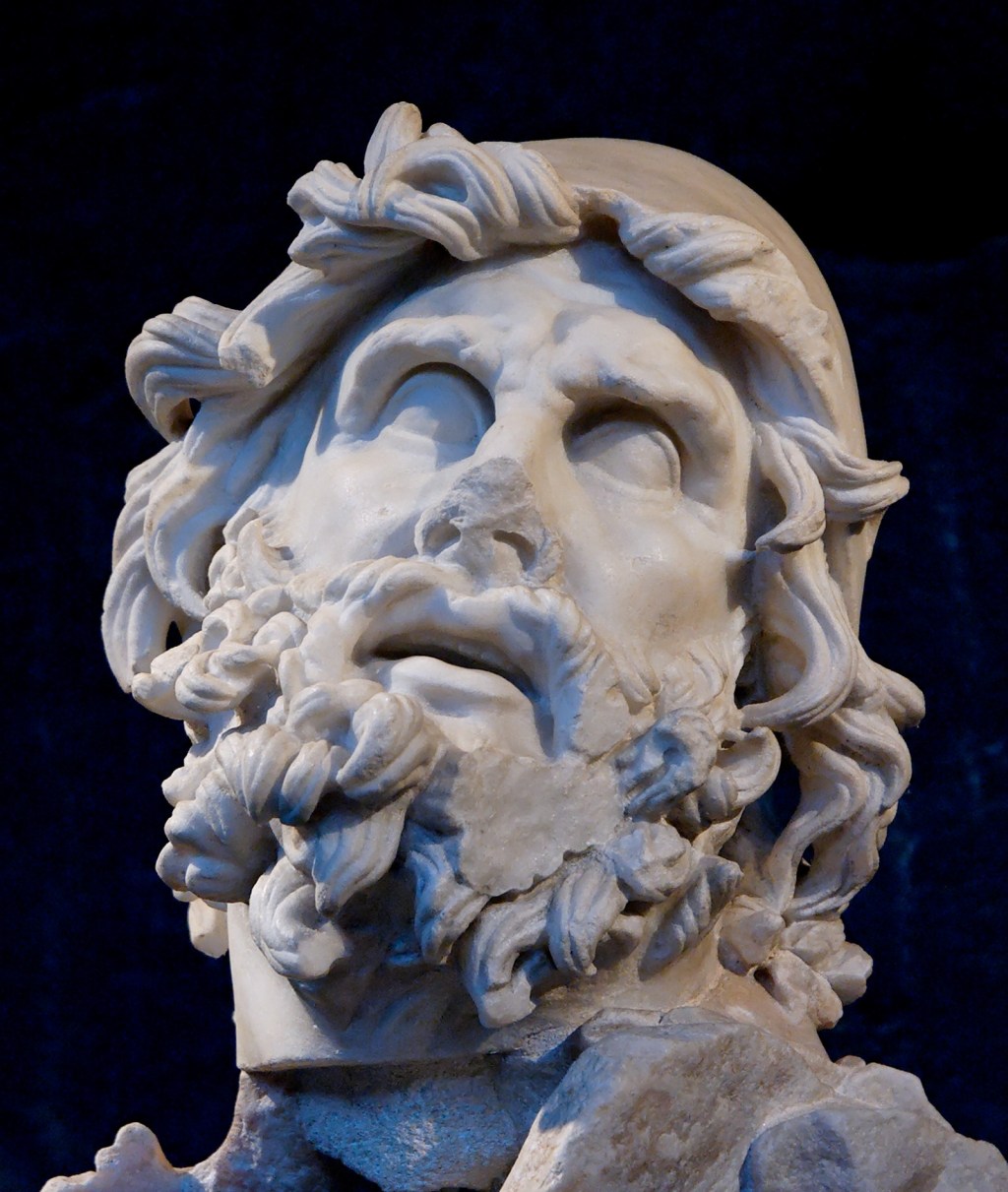
Let’s get to the point. These are the reasons why I was irritated by Chris Nolan’s Odyssey:
- It’s a cheap attempt at diversity. Hollywood has been giving me the impression that it’s not confident stories from other cultures would be “safe” (i.e., sell). So they decided to adapt a well-known, popular IP and throw in a diverse cast so they can tick off the diversity box.
- It’s cynical marketing. I’m 100% sure Nolan and the marketers know that by throwing Odyssey into the US culture wars, it would go viral, and thus people would watch it out of curiosity.
- How another country’s cultural product became cannon fodder for the exhausting US culture war. I’m so sick and tired of how almost every movie becomes a battleground for left- and right-wing politics. Can we just watch movies without being inflicted with this constantly?
- Both the right and left sides of the debate often use ignorant, ill-informed, and often bigoted reasons to defend their points of view.
- The US debates are very loud and numerous online, so Greek voices and other opinions outside the culture war dialogue are drowned out, and worse, dismissed. “It’s just a fantasy; authenticity shouldn’t matter.”
FFS I just want to go to the cinema, get some popcorn and enjoy a movie without having to see these battles played out on social media. But this is the world we live in now, sadly.
Anyway, I wanted to deeply explore why I was so disturbed by what Nolan did. However, I didn’t want to just consume all these YouTube videos from the US culture warriors. I went on a deep dive, and what I found was shocking:
There’s an insidious reason why Greek presence, heritage, culture and history have been removed from the movie.
It’s a symptom of a 200-year-old imperialistic, intellectual paradigm about Greece.
According to Farya Faraji, a Canadian-Iranian musicologist, Nolan’s creative decisions were unsurprising because he is just continuing the Northwestern European intellectual tradition, cultural imperialism, appropriation and ethnocentric view of Greek culture.
Edit: I completely forgot to add his wonderful video explaining all this in my first publishing attempt. Sigh! I hope you watch this, it’s very informative.
This intellectual tradition:
- “Westernises” ancient Greece by downplaying its Eastern Mediterranean and West Asian heritage and influences.
- Claims Greek culture as the foundation for Western culture.
- Has an almost unconscious desire to portray Greek culture as more “white” and “Western” so that this claim is more legitimate and narratively aligned.
This led me to discover a more shocking insight: the idea that modern Greeks are not considered white, and because of that are not considered inheritors of ancient Greece.
There’s this assumption that ancient Greeks were “purer” and more Nordic white (white, blonde, etc.) before they were “tainted” or “sullied” by the Ottomans.
As a result, modern Greek people are not considered inheritors of the ancient Greeks due to this “corruption.”
Condescendingly, some powers that be believe they (the Northwestern civilisations) are better caretakers of the Greek heritage than the Greeks themselves due to this.
Yiannis Baboulias also echoes Faraji’s thoughts, saying that “…classical Greek inheritance had migrated north and west and that the living Greeks were not its rightful custodians, contributed to a 19th-century German cultural framework in which that inheritance could be claimed by others entirely.” – On the Odyssey, because
From Greek City Times’ Nolan’s Odyssey Problem: Diversity Without Greeks Is Not Diversity:
“Greeks — like Italians, Armenians, Slavs and other Mediterranean or European ethnic groups — often occupy an awkward category within American racial politics. They are considered ‘white enough’ to be excluded from representation conversations, yet still ethnically and culturally distinct enough to be mined for mythology, history and aesthetics.Hollywood wants the cultural prestige of Homer without feeling any obligation toward Greek cultural representation itself.”
Maria Stenos wrote a good piece about how this cultural appropriation became set in stone, so do read it: Diaspora Grief and the Hellenic Double Standard
“Greeks became marginalised within a Western academic landscape that preferred sanitised versions of Ancient Greek history over living Hellenic scholarship. The classics had been deemed shared inheritance, homogenised under the monolith of Western culture; modern Greeks were simply an inconvenience to that story.” – Maria Stenos
My mind is blown by how terrible and unjust this is
This discovery has been challenging for me to process; I’m literally in disbelief as I wrote this in my journal:
So let me get this right. Some countries liked what they saw in Greece’s literary, cultural, and artistic traditions. They liked the prestige of having been formed by this thousands-of-years-old culture, so they appropriated it for themselves and said that their culture came from the Greeks. But then they discovered that the Greeks were not what they thought they were—meaning they were actually influenced by various cultures around the region, such as the Ottomans. You know, distinctly not like them. Not Western.
That becomes an inconvenient narrative because the heritage you claimed as yours actually came from a non-white, multiracial background. This is terribly inconvenient, so you decided to exclude this multiracial heritage. In fact, in the end, you excluded modern Greeks entirely because you believe they were influenced by and intermarried with peoples of other countries in the region, making them, in your eyes, not as “pure white” as you would like.
Over the years, you get comfortable with the belief that Western civilization has its foundation in Greek history, yet you refuse to acknowledge the Greeks, the originators of this culture.
Can we all say euw together?
I think most people aren’t even aware of this very long, centuries-old dynamic existing and playing out to this day because “Greek culture is the root of Western civilisation” is just taken as a fact when… well, it is probably not true?
I discussed this with a friend, and we were wondering – why won’t the French or the Germans claim Beowulf as the foundation of Western civilisation instead? Why Greek culture? Is it because it’s older and more prestigious?
Anyway, my mind is blown.
To the Greeks out there upset about what Nolan did: I hear you. I can’t imagine having the agency over my culture taken like this. I can’t imagine having my right as an inheritor of my own culture questioned due to some myth about the lack of my blood purity. Worse, to have my cultural products used like a football for someone else’s ideological battles…?
Despite being a Peranakan woman, my right to my Chinese heritage was never questioned, nor have I met any mainland Chinese who did not view me as a fellow Chinese and “child of the motherland.”
I remember having a conversation about this with a Chinese mainlander on Xiaohongshu. I told her how some people don’t consider me Chinese enough because of my lack of skill in Mandarin. The person expressed shock at such a thing. “What nonsense is this? There’s no question that you’re a child of China and a sister!” she exclaimed.
(Of course there are extreme nationalists, however, that would think otherwise, but they are a rarity.)
Using another country’s cultural products to promote an ideology
So that’s why Nolan’s actions are adding salt to the wound, especially for the Greeks.
The Odyssey’s original meaning and themes have been replaced by an ideology that is not Homer’s. Instead of seeing the Odyssey from the worldview of the creator, Nolan chose to contort the Odyssey to suit his worldview, which is postmodern, nihilistic and devoid of spirituality.
I have no doubt that Nolan’s Odyssey will be entertaining because the man is a master entertainer and cinematographer.
It could even be a box office hit thanks to all that controversy and viral marketing.
However, those who are Greek and revere their Greek heritage, and those who love history, would probably not enjoy this movie, knowing what has been done in the name of entertainment.
-
July 2026: Lestat, OpenCode and the art of resting

I’m currently towards the tail end of my leave after a medical procedure. I cannot believe time has flown so quickly. When I first got the leave chit, I thought to myself: So many weeks! What in the world am I going do during this time?
But now at week four of my leave, I’m feeling a mild tang of panic as my leave draws to a close. Recovering from this medical procedure had been more challenging than I had anticipated – mostly due to the anxiety of reading too many alarming Reddit threads about said procedure, and also because living in an apartment with zero lounging furniture (I have no sofa because I sit on the floor most of the time) and a too-hard mattress (I’ve been meaning to buy a topper but kept delaying it) was less than ideal for recovery.
Also, not gonna lie, I suck at resting most of the time. My mind is often whirring with ideas and new projects. And having to, I don’t know, sleep feels like a waste of time.
So, I often end up working at my laptop on personal projects even when on medical leave. But this time my body wasn’t giving me any leeway. I have to rest (preferably horizontally) whether I like it or not, and it makes its opinion loud and clear.
So, I’ve been catching up with the many, many Chinese dramas and Hollywood shows that I’ve been dying to watch but simply had no time. Massively enjoying The Vampire Lestat, and highly enjoying Sam Reid’s depiction of the golden-locked Lestat. The team really selected the right actor to play the bratty prince.
Chinese dramas that I’ve caught up with: The First Jasmine (fantastic), A Splendid Match (so-so to terrible). I may attempt The Mirage next, only to see what the fuss is all about.
Despite my body’s insistence that I not use my brain cells, I still managed to tidy up a few reviews for my Dramatea blog, so I’ve scheduled a number of drama reviews for the next few weeks.
Learning OpenCode and coding agents
On the learning front, I stumbled on OpenCode School and I’m in heaven. It’s just so fun. I’ve discovered the magic of coding agents as a writer’s tool and I’m in heaven! Once you’ve touched a coding agent like OpenCode, you will find it difficult to go back to chat, which makes me grieve a little for the money I spent on my premium Typing Mind purchase. 😉
Speaking of coding agents, I did dabble on a number of them. I have a soft spot for Antigravity 2.0 (so hated by the community right now) and to be extremely honest, it’s slicker and less janky (if at all) than OpenCode, which still has some ways to go to improve its UI. I only use Antigravity for work, however.
Why OpenCode, then? Well, blame it on my stubborn nature which refuses to be boxed in by a walled software garden, no matter how slick and pretty. (A big reason why I found Apple products suffocating and left it).
I can only rave and rant about AI with software engineers, but I so wish I could find a fellow writer who uses AI like I do so that we can exchange notes. Each time I write a writing + AI post, all I get are insults from the writing community, which saddens my soul. If only they know how much it has made me happier as a writer.
-
The Last Generation of ‘Bananas’? How Malaysian Chinese Identity Is Transforming

The English-educated Chinese in Malaysia are dying out, and that could be a good thing.
I am what many Malaysians would call a banana: Chinese, but more proficient in English.
To others, I’m not “banana” enough, because by some freak of geography and luck, I can converse badly in Mandarin and in a rare form of Hokkien, the northern version spoken in Penang. But that doesn’t mean I’m Chinese enough for the Chinese-educated, who still firmly consider me a banana because I can’t read well, nor have I read the Chinese classics. So I exist in a weird in-between place.
But I think it’s a good thing. It has enabled me to see perspectives from both sides. And I really think it’s a privileged position to be highly educated in English and middling in Chinese education.
The Divide
Note: Malaysia’s education system is… complex. You can choose to go to vernacular schools where you are taught in either Chinese or Tamil, or you can choose to attend national schools (English and Malay) or international schools (mostly English).
For the longest time, I come from a generation of Chinese who thought that Chinese education was inferior. My mother used to tell me that if I was educated in a Chinese school, I would turn out different or think differently. Just how differently, I’m never sure, but there’s no denying the gap between English-educated and Chinese-educated Chinese.
It takes a lot of brains, effort, and motivation to burst out of these educational bubbles. As an English-educated Chinese, it’s rare for someone like me to learn Mandarin on my own. In Chinese-educated circles, you probably need a family that speaks fluent English and an interest in anything Western to escape the Chinese cultural bubble.
As a result, some Chinese are so Chinese-centric that they only have Chinese friends, work in Chinese places, speak Chinese 98% of the time, and consume only Chinese media. On the other end, we have Chinese bananas who dwell only in English-speaking spaces, consume English media and have friends who speak in English.
I remember a time when consuming Western media and its narratives meant you ended up mirroring them—often awkwardly, especially when you’re Chinese and don’t realize these narratives might work against you. Yet, for some reason, you still support them.
Take 2008, during the Beijing Olympic Games. I had two banana friends with wildly different reactions. One was enormously proud to be Chinese because of what he saw on TV. The other wore Tiananmen Square T-shirts to work every day and took every opportunity to remind everyone that the Chinese government violates human rights. I sat somewhere in the middle, confused by it all, because I exist in both worlds. I understand Mandarin and Chinese perspectives, and I understand Western perspectives, but I don’t know exactly who to choose. So I didn’t choose anyone.
One friend loves to speak French as often as she can, as if to show off how Francophile she is: I can speak French. I lived in France. I had a French boyfriend.
The other was learning Mandarin. I look at this and think: This is what it’s like being a Chinese diaspora, conflicted between two things. I realized this is what it’s like being a Chinese banana—divorced from your culture and not knowing how or where to stand.
Roots: The Peranakan Story
Watch this documentary above to understand the creole culture of the Peranakans or the Baba Nyonyas. These are my people. ☝️
In many ways, I’m the same, but not torn between the West or China. I’m an unique: My ancestors are Peranakans—imagine the Creoles of Louisiana, and you’ll get the idea. This is the Malaysian version.
Peranakans came to Malaysia in three waves. The first was during Admiral Zheng He’s time, at the height of the Ming Dynasty in the 15th century. Between 1405 and 1403 AD the legendary admiral traveled the South China Sea, Indian Ocean, and East African coast by ship. Malacca was one of his ports of call.
Legend has it that he brought a princess who married the Sultan of Malacca, and from there descended the Peranakans. She brought a retinue of people who stayed, intermarried, and created a culture that was a mix of Malay, Chinese, and—believe it or not—British. Yes, British, because the Peranakans were Anglophiles. We adopted English dining habits, and our children were educated in English missionary schools. My family had a strong tradition of sending their kids to these schools.
When you come from this background, what is cultural purity? I don’t understand it. All this talk about being “100% more Chinese” or more this or more that doesn’t make sense to me, because I come from a culture that happily adopted all kinds of cultural tidbits from various places.
My ancestors were part of the second wave of Peranakans in Penang. During the fall of the Ming Dynasty around the late 17th century, many Chinese, mostly men, fled to Malaya. They intermarried with local Malay women, and many didn’t stay in Malaya. T
They were sea merchants, often leaving home to do business abroad, which explains why Peranakan culture is very matriarchal. The women ruled the house, and the men went out to find work. I descend from these people. I am essentially mixed race, though it’s been many centuries. I look 100% Chinese, but my DNA will probably says otherwise.
Why Bananas Are Fading
So why do I say it’s a good thing that bananas are dying out in Malaysia? Bananas have always consumed so much Western media. Due to the language barrier, they don’t understand their Chinese side much. They don’t get the narratives as much. But now, many Malaysian Chinese families—including banana families—are sending their children to Chinese schools.
I spoke to a Chinese banana friend who came from a banana family but was sent to a Chinese school. He honestly said he hated being educated in the Chinese school system, probably because he was a banana. There was a cultural clash. But today, he’s able to read in Chinese and converse fluently in Mandarin. I envy him. Although I have good listening skills, my speaking is still shit. When I speak, I’m so afraid because my tongue keeps tripping over itself from lack of practice. I’m not as fluent as he is. I envy his ability to bridge both cultures without effort. I want to be him.
The Ideal Future
Ideally, the next generation of Chinese in Malaysia will be fluent in Chinese but also retain the ability to understand the West, like the bananas did. Of course, the danger is that they might end up leaning too much to one side—like being so pro-China that they forget other narratives exist.
That’s why I say it’s maybe a good thing. The status quo wasn’t working well for the Chinese community. Having the Chinese community divided into English-educated and Chinese-educated wasn’t fun. When you’re like me, somewhere in the middle, it’s very odd.
The Chinese-educated looked down on the bananas. The bananas looked down on the Chinese-educated, while secretly probably envying each other. Back then, the Chinese-educated were more envious of us, because English was the dominant business language of the world, so they felt at a disadvantage. But now it’s the other way around.
Interestingly, more non-Chinese parents are sending their children to Chinese schools.
-
Subscribe
Subscribed
Have a WordPress.com account? Log in now.

