-
“A Righteous Smokescreen”
Interesting article I read today: How American Culture Ate the World: A new book explains why Americans know so little about other countries.
This was a mystery I have been trying to decipher for the longest time. Why do some Americans have such bad geography skills? Why do they know so little of the world outside America?
The article is a review of sorts of the book, A Righteous Smokescreen: Postwar America and the Politics of Cultural Globalization by Sam Lebovic. Something I need to get on my ebook reader stat!
“… just as the U.S. took command as the planetary superpower, it remained surprisingly cut off from the rest of the world. A parochial empire, but with a global reach.”
How American Culture Ate the WorldSummary
- US culture dominates the world. The French called it “coca-colonisation”.
- While America exports most of its culture to the world, it barely imports the world’s culture, so her people remain largely ignorant of the world.
- This parochial attitude has its roots in history. A racial quota immigration system and ideas not in line with American ideals are restricted at the borders.
- While things are better now, this inward-looking behaviour not reversed. (Why, though?)
- Perhaps it is because its media ecosystem, which is described as “an American echo chamber”, has not changed nor expanded its content to include the world.
- Also, the world’s Web 2.0 activities is corralled into the platforms of a handful of American companies.
- American Conservatives long for homogeneity, conformity and racial and social hierarchies.
- Liberals long for the central role of the US as the world’s “peace police”.
In conclusion…
The American national security state, bulkier than ever, continues to exclude foreigners on ideological grounds. America’s culture industry has not stopped its mercantilist pursuits. And Web 2.0 has corralled a lot of the world’s online activities onto the platforms of a handful of American companies. America’s geopolitical preeminence may slip away in the not-so-distant future, but it’s not clear if Americans will change the channel.
Interestingly, this is the opposite situation in Malaysia. We not only consume American culture, but also from other places. Our cinemas screen American & European, Chinese, Indian, Japanese and Korean movies. Our newspapers have world news from every part of the world. I cannot say that every single Malaysian is informed about every part of the world, but they are exposed to thoughts and ideas from all corners of the world. Except maybe Africa. We really don’t have enough news and content from that continent!
When I was one of the world news editors of a national paper, I’d have to scroll the wires to put together the world news section of the paper. My sources include: Asia News Network (which includes all the major papers in Asia, including South-East Asia), AP, AFP, and Reuters. Our news sources include reputedly “state controlled” outlets such as China Daily and SCMP, and media the US views with suspicion such as Al-Jazeera.
This exposure has given me rich insights on how differently every part of the world thinks about the same issues.
This education has been invaluable for me, and most probably informed my point of view on the current US and China tensions which I wrote in my recent article: “Being Chinese in an anti-China world.”
It has taught me that the world is amazingly complex, and approaching it from a black and white, this is “right and wrong” perspective is limiting and also dangerous.
-
Walks in the morning
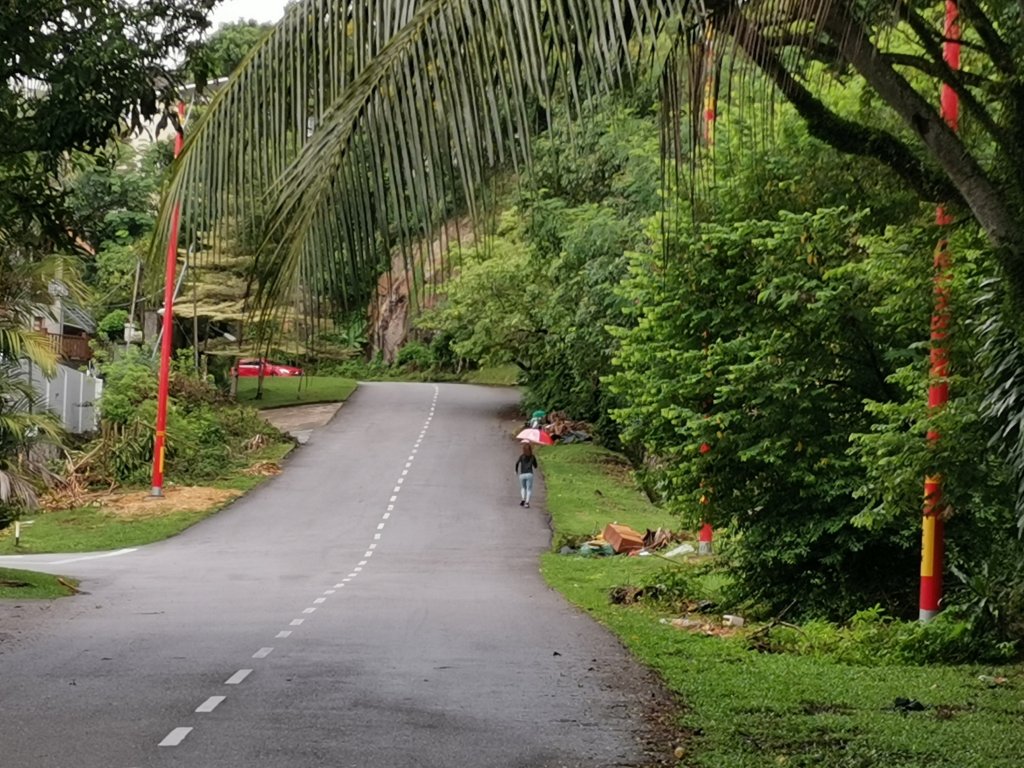
It was a rainy morning but that didn’t stop this exerciser from her walk. The red poles are solar-powered street lamps. If I don’t start my day early in the morning walking while the sun rises, I know that it will be a less than ideal day. A few days ago, I grabbed my Nordic poles and went out walking despite it being a drizzly day.
I let the rain fall as I walked/poled around the neighbourhood. Since Nordic Walking is not exactly a common sport I must look weird, and I try not to feel so self concious about it, but it’s hard when I get the occasional curious look thrown my way. Around 10 minutes before I got home, it started drizzling in earnest, and I was damp by the time I got home. However, I thought of it as a free shower lol.
My neighbourhood is absolutely lovely and a rare gem, and one of the reasons why I chose to live here is because there are shops and major malls LRT stations within walking distance. But the prize is the greenery. I live on top of a hill skirted by a little forest. I feel extremely lucky to live here, so close to shops and nature!
People walk around the neighbourhood all the time because of this. And I find that I’m more active and healthier too as a result.
-
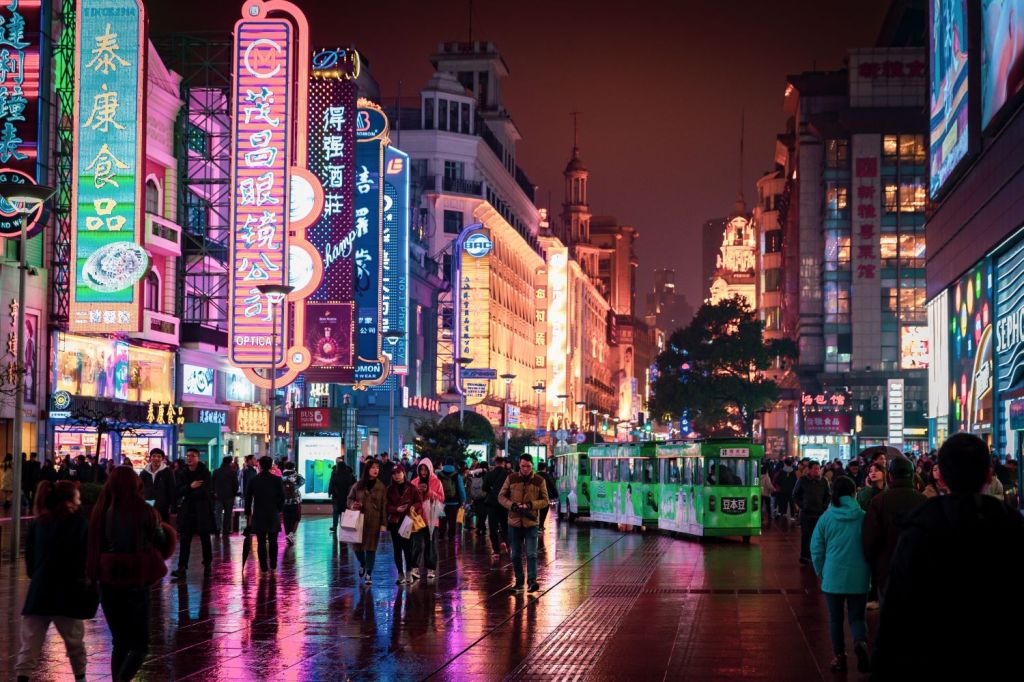
Being Chinese in an anti-China world

Subscribe to continue reading
Subscribe to get access to the rest of this post and other subscriber-only content.
-
Weekend Tales #2
Subscribe to continue reading
Subscribe to get access to the rest of this post and other subscriber-only content.
-
Mission: Impossible – Dead Reckoning Part One – quick thoughts

Not gonna lie, but my first thought was: Another franchise movie? Are you serious?
But due to the lack of choices in the cinema these days, Mission Impossible 7 was the most interesting thing around, so my friend and I decided to give it a try.
After my encouraging response to yet another franchise movie, Indiana Jones and the Dial of Destiny, I thought this should be okay.
Well, it was more than okay, I actually enjoyed it a whole lot, but not as much as Indiana Jones. Perhaps it is because I was more attached to Indy the character than I was with human assassin cyborg Ethan Hunt, but the main culprit of my not-as-enthusiastic response is due to Mission Impossible 7‘s terrible dialogue.
Mind you, the movie hit its action plot points like a pro, but the people are talking like, to quote my friend: “Mansplainers.” To be more specific, “Mansplainer robots”.
Take that opening scene where a bunch of CIA spooks sat around in a top-secret room looking all smug and schemey. It was basically an info dump scene where each of the character was telling us what was happening. They were telling, not showing. It was lazy ass writing. And it was awful.
My jaw dropped, and I turned to my friend. “Nobody talks like that in real life, not even CIA agents!”
Especially CIA agents.
This weird dialogue quirk continued to be distracting throughout the nearly three-hour movie. It didn’t help matters that there was a noisy toddler yelling his head off at random moments during the movie. I don’t know why, but Malaysian parents love taking their toddlers to movies that they shouldn’t be in. I was particularly nervous about the baby sleeping at a young mum’s lap a few seats away, but that infant seemed to regard the yelling, screaming and shooting sounds as a form of lullaby. Can I have what he’s having?
So, anyway, it’s not a bad movie, but I have no idea how it deserved its 96% score at Rotten Tomatoes. Are they saying it’s as good as one of the Lord of the Rings movies? It is definitely not that good.
I have a theory: The deluge of Marvel Cinematic Movies and superhero flicks are making people desperate for something different. Just anything but superheroes. Also, it doesn’t help that these movies have become a tad preachy. People are just so starved for quality, unique, non-preachy cinema these days that Mission Impossible 7 felt like a breath of fresh air.
It’s more like we’re going back to the 90s and early 2000s and that may not necessarily be a bad thing!
This kinda makes me feel slightly depressed for the state of cinema in general — Western movies and television have stopped being fun, experimental and adventurous. It has become politically correct, safe and preachy. I’ve been turning more and more to Chinese and Korean dramas, only because you can still find some originality there.
People just want to go back to good ol’ days where you can just chuck your brain aside and enjoy yourself.
Can we have the old Hollywood back?
-
Why I Left Apple’s Ecosystem
I had a Macbook Air, iPad, iPhone, and was about to buy an Apple watch to complete the set. But last year, I did an about-turn. I ditched my Macbook for a Thinkpad, got a Huawei phone (a hand-me-down), and a smartwatch.
Was it because I wasn’t happy with the quality of Apple products? No, in fact, I admit the build and design of Apple products are superior. I always felt as if I was working on a piece of art each time I used an iPad or Macbook. And I still happily prefer my iPad over my Samsung tablet.
So, why did I leave the Apple ecosystem? Let me roll out the reasons for you.
Reason #1 Apple’s walled garden
Apple products are designed in such a way that you have to stay in their ecosystem. In a way, it’s cool that their products work seamlessly together. However, you’d end up dealing with lots of limitations. For one, I find it difficult to find Apple-compatible gaming software and I grew frustrated having to only use Apple-only products. For example, I couldn’t buy third-party iPhone chargers because they stopped working after a few charges. And what’s with removing ports so that you have to buy their latest thingamajic to get the same functionality? That annoys me the most.
Reason #2 I’m denied right to repair and upgrade however I want to
In Malaysia, where I live, we have computer shops that cobble together a PC for you according to the specs you want. If I wanted to upgrade the desktop to a better version, all I had to do was go to the shop and ask for a part or two to be upgraded.
Apple doesn’t give you that kind of freedom. You need to repair your items in shops approved by them. You need to buy stuff from shops approved by them. Fortunately, in good old Malaysia, we have cowboy outfits that openly repair iPhones, and most of us go to them for that.
In a way, I get that it helps Apple control quality, and it’s part of the reason why Apple products “just works” is because it is a closed ecosystem.
But I disliked having to upgrade just because they deemed my device “too old”. I hate having to buy a new thingamajig when my old dongle worked just fine – just because Apple removed a port. I hate that I can’t repair my MacBook or upgrade them independently.
Reason #3 When you are locked into their ecosystem you gotta do things their way
Closely tied to Reason #1. When you are reliant on one company to provide you the products you need to use to earn a living, you have to just accept whatever changes they roll out.
I discovered it the hard way when I wanted to use an app, but my current OS was not compatible. But when I tried to install the new OS, they said I didn’t have enough cloud space, so please buy some so that you can install the new OS. It was ridiculous. I knew that the tiny amount of hard disc space was going to bite me in the ass one day, but I’ve only used the Macbook for three years and I barely installed anything!
Fortunately, after much cleaning up, I managed to install the new OS, but just barely. But I found myself looking hungrily at the generous amount of HD space that the Thinkpad was offering … at the same price.
I never forgot the feeling of helplessness when a pop up appears that I need to do this or that to do a basic function. And that task usually involves money.
So that’s how they profit from us, byte by byte, install by install.
I grew really tired of being locked behind any ecosystem of products, services and forced upgrades. Apple lost me because of that – I hate being told to upgrade just because Apple has deemed my version of iPad obsolete. Or having to buy cloud space because they gave me a barely functional amount on my laptop. PCs not only give me a better deal for the same amount of money spent, I enjoy the freedom it offers, and in the long run, it is just more cost-effective.
Reason #5 It is f**king expensive
What most folks in the West do not realize is that Apple products are EXORBITANT in Asia. People get in debt to “afford” them, just to flash an iPhone to look cool.
But then there’s the whole Foxconn Apple scandal where workers were made to work in horrible ways just to meet their exacting demands.
I read about the whole thing in the book, Haunted Empire: Apple After Steve Jobs. In fact, after reading the book, I had such distaste over their corporate practices that it made me feel like a saint for leaving their ecosystem.
Now, I’m not the sort to announce on social media that I’ve stopped using a product because the CEO is a Nazi or something. (Though it will probably hasten my search for an alternative.) Mainly because having a purity stance is problematic. Every company in the world is tainted in some way. The best we can do is to choose a company that can fulfill my needs ethically. It’s often a losing battle as there are far too many skeletons in corporate closets to keep up with.
But what really gets my goat about the whole Foxconn thing is how Apple, despite charging exorbitant prices, are treating the workers that are actually making the products that make them their profits like sh*t. Wait, you say. Apple doesn’t control Foxconn, other people are doing this to the workers. But as I read the book, Haunted Empire, it is Apple’s demanding ways that caused Foxconn to turn the screws on their workers, and Apple is conveniently closing one eye.
Reason #4 The zealotry of Apple fans
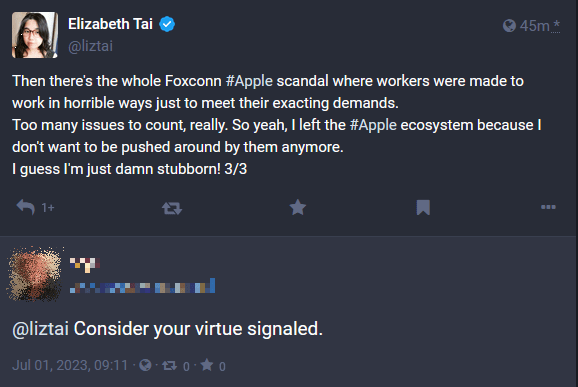
Behold, the Apple fanboi I never understood the zealotry around Apple. It’s like a religion or something. And I shy away from all cult-like thinking. I am wary of brands that foster such slavish fan worship. It disturbs me and I don’t want to be a part of that.
Reason #5 I miss my freedom and options
It’s the same reason why I left Twitter and Facebook for Mastodon. Why I embraced IndieWeb and now blog the POSSE/PESOS way. I realised that Apple products, shiny and high quality as they are, were trapping me in one way of doing things. I could see a time when I became so dependent on Apple products that I couldn’t break away, so I broke away the first moment I could. I do miss the sleekness and “it just works” feel of my Apple, but I wasn’t willing to pay insane prices just to do my work when PC-related products could do it for me just fine.
So yeah, in a nutshell, I left the Apple ecosystem because I like my freedom too much, and I was just getting way too nervous being so dependent on one company!
-
Indiana Jones and the Temple of Political Correctness
To my surprise, I loved Indiana Jones: The Dial of Destiny. It had a lot of good ol’, classic Indiana Jones moments: The crazy chase, the ancient tombs and traps, bugs and snakes. It’s a movie where you need to switch off your brain off and enjoy it. Watching it made me feel like a kid again. It was a perfect send off for one of cinema’s most iconic characters.
Yet, if you had looked online, especially on Youtube movie channels, you would have thought it was terrible.
These days, I do my best to avoid any information about upcoming movies. I’ve long realised that reviews or even the non-spoilery opinion of people tend to colour my perception of movies.
We don’t seem to enjoy movies for the sake of it this days. We always have to tie it with some serious commentary on culture, politics and gender.
Maybe it has to do with the need to create content in a way that pleases the algorithm: saying something that will provoke a big emotional reaction. And creators love to provoke anger and indignation because that’s where you get all those juicy comments that algorithms like.
That said, let’s talk about the most controversial Indy movie: The Temple of Doom.

Naturally, after returning from watching The Dial of Destiny, I rewatched Raiders of the Lost Ark and then, The Temple of Doom.
And yeah, it’s as wildly politically incorrect as I remember it. 😅 All the unflattering depictions of india that you can imagine. That meal at the palace, for one, was especially cringe worthy. As far as I know, Indian cuisine did not include snakes, monkey brains or other manner of creepy crawlies. As many Indians are vegetarians, I can imagine the indignation that must’ve provoked!
Temple of Doom would have been eviscerated in today’s social media and would probably never have been made.
Yet, I loved The Temple of Doom because of its sheer over-the-top hamminess. It was just a fun movie, and while it was not my favourite, it sure gave me a good time when I watched it — even in the politically correct times of 2023.
Creativite works will always be confronting and challenging. Not to say that The Temple of Doom was right in what it did (I think they could at least not insult Indian cuisine!), bu it was an over-the-top, straight out of a pulp novel story and was never meant to be taken seriously.
I think we have forgotten to just park our brains aside and enjoy movies. Everything must be evaluated for political and cultural correctness these days. Every movie is now yelled at for being “too woke” or “anti woke”. Why have we gotten so stodgy?
-
The puritanical pursuit of platform purity
Subscribe to continue reading
Subscribe to get access to the rest of this post and other subscriber-only content.
-
Subscribe
Subscribed
Have a WordPress.com account? Log in now.

