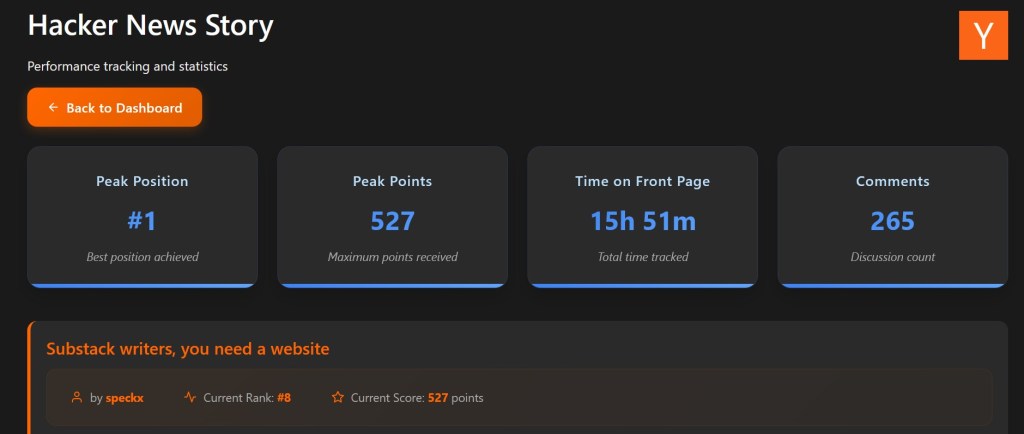
A couple of weeks ago, Fabrizio of Passo.uno dropped me a message on LinkedIn and told me that my article, “Substack writers, you need a website!“, was No.2 on Hacker News. I thought he was pulling my leg.
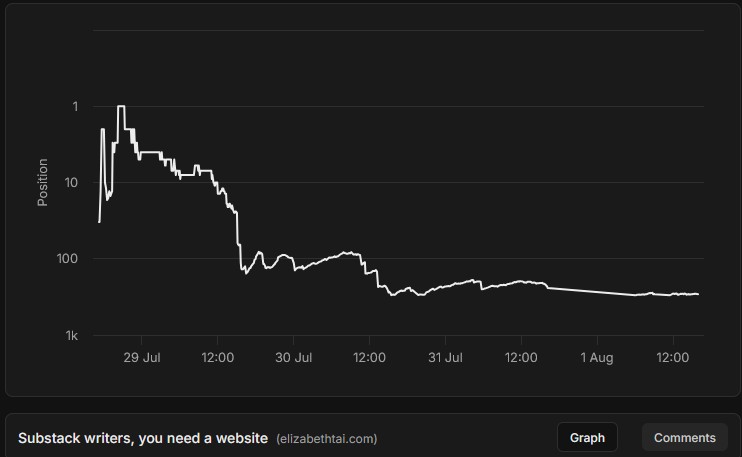
I checked Hacker News and indeed it was true: My essay was on the front page. By the time I checked, it had dropped to No.6, but I visited hnrankings.info to check the historical movement of the essay and saw that I was actually No.1 for a brief period.
I was absolutely stunned.
For one, although I do write about technical issues as a technical content writer and as a personal hobby, I am not technical-technical, if you know what I mean. Hacker News, the digital rag of SWEs around the world, highlights essays that I sometimes can barely comprehend. So, to be No.1 on that website is something I don’t even dream about.
It’s also a bit ironic, because the content of the blog post itself kind of proved my point. Before Hacker News picked up my post, it was actually selected by WordPress.com to be placed on the front page of its Freshly Pressed page. That was already a big deal for me.
When WordPress.com decided to highlight my post, I didn’t realize it. One day I just randomly noticed that the post was getting way more comments than I was used to. Usually I get about five or six comments at most, but on that day I discovered I had 50 comments. I thought maybe it was a fluke, or that somehow the topic had just resonated with people. Then I saw an email from WordPress.com telling me that I was selected to be featured on their Freshly Pressed page. I got a lot of eyeballs due to that, which was great and made me pretty happy.
I firmly believe it is because of what WordPress did that I got noticed by the person who shared my article on Hacker News.
This would not have happened if I had published the post on Substack. For one, Substack tends to promote its superstars (i.e. those with a lot of subscribers, paid, preferably, and often not from my part of the world. Ahem.) Also, I doubt it’ll promote a post urging writers not to use Substack as their digital homes!
Still, it proves my point that promotional channels are equally important. If not for WordPress’s Discover page and Hacker News, I probably would not have been noticed at all.
Curiously, my Substack post highlighting the essay, Writers, don’t make Substack your digital home! is getting an uptick of comments lately. 32 comments so far! Highly unusual as I usually get less than a dozen comments, and usually from my usual readers. (FYI, I usually offer a bite-sized, behind-the-scenes version of the essay on my Substack, and invite readers to read the full essay.)
I think my essay coincided with a zeitgeist moment. I happened to write about Substack days before they rolled out their new Pangram AI detection feature.
People were already fed up about the state of platforms in general – what Cory Doctorow famously calls enshittification. Pangram was an “I’ve had it” moment for many Substackers already weary of being tossed around by lack of moderation, algorithms, rules and now a feature that may subject them to witch hunts. Pangram was the last straw.
Why writers need a website they own
My article, “Substack writers, you need a website!” was something I wrote out of frustration from what I’ve been seeing.
A lot of Substack writers are far too dependent on the platform to house their content. As the platform introduces more and more features they don’t like, many are complaining on the feed.
My frustration is borne out of the fact that many don’t seem to be aware that they can escape this “loop of doom,” so to speak. They don’t have to be trapped in this situation nor do they need to treat the platform as an be-all and end-all.
I also noticed that a lot of writers seem to think they can only choose between having their own website or being on Substack. The truth is, writers need to have a digital home that they own, and digital home means owning a domain name. It doesn’t matter what you build your site on—whether it’s WordPress, Ghost, or even Substack, really—as long as you have the domain name, you own the content. It’s like an address you keep forever.
However, if you don’t have a domain and your content lives on something like xx.substack.com or xx.wordpress.com, then the domain authority or “SEO juice” doesn’t belong to you. It belongs to those platforms. That’s why I’ve always championed the fact that you need to have your own website.
But a lot of writers I speak to are reluctant to do that, mostly because they are not technically inclined and feel overwhelmed by the thought of creating their own site. Perhaps it was incredibly hard to create a website in the 1990s, but it’s really much easier right now. There are so many services out there that can help you build your website without a speck of coding on your part. Heck, you can even vibe code a simple static website with ChatGPT if you want.
I realise I’m talking from the point of view of a technically inclined person. I work in tech, use software that would probably make most writers cross-eyed, and even build AI workflows in my company. But I’m telling you, it is not as difficult as you think.
For example, many would probably blink at my choice of hosting my website on WordPress.com. Although I have the technical skills to create my own static website—and did indeed build one at one point—I prefer to have other people manage it for me so that I can concentrate on writing. I chose WordPress.com because it’s one of the most common content management systems (CMS) on the internet. If WordPress.com doesn’t work out, I can easily port my website to another provider.
One day in the future, perhaps when I’m retired (because right now I’m too busy to even think about it), I hope to build my own static website so that my content is in Markdown first and then ported to the internet. But right now, the thought of doing that makes me tired because I have literally thousands of articles on my website. I’ve been publishing on elizabeththai.com since 2012 and have never really stopped, so it’s almost a 15-year footprint to port over. It’s not something you do lightly.
P.S. I have actually managed a few content migrations from one CMS to another for companies I’ve worked for, and I can tell you that each of them made me sweat bricks because they’re often not compatible. And even if they have an exporter feature, you’d have to clean up bugs and mangled content. If I were to migrate my own site, I would probably get professional help because there are far too many things that can go wrong in the process.
Still, some writers are not entirely convinced they need a website.
Many tell me they use Substack because they don’t get traffic to their own websites. Sure, that’s 100% true. Putting up a website doesn’t mean you’ll automatically get more traffic. In fact, it’ll often be the opposite due to the way the Internet is right now with SEO, and worsened by the fact that AI is now bypassing search engines by recommending websites instead. (Right now, corporations are having a headache trying to ensure their content gets recommended by the “answer engines”.)
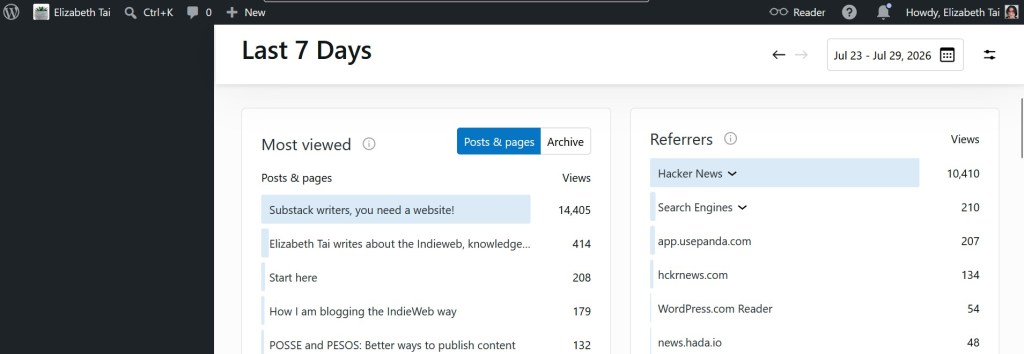
I don’t get much traffic to my website most of the time (proof below); I’ll be surprised if I get a few hundred views a month. Perhaps I’m weird, but I do not care about traffic nor do I care how many subscribers I have. I care about my content having a home. I care about my content having an address that I own—meaning my own domain.
So, the key for writers is to stop focusing on subscriber count or traffic. Focus instead on quality readers and engagement. Do your subscribers engage with your content? Leave comments? If you have only 100 subscribers but 30% of them talk to you via comments or social media, that’s far more valuable than having 100000 subscribers and no one bothers to engage with your content.
And whether your content goes viral and reaches tens of thousands of readers or not, don’t you want that traffic to go back to your website where people can discover your other content?
Having a digital home means that when one of your posts does go viral (whether recommended by sites like Hacker News or a Claude chatbot), people can find the rest of your work. Maybe they’ll even become a loyal subscriber.
In that essay, I pointed out that writers like John Scalzi have been blogging since the dawn of the internet. His digital footprint is massive, spanning decades. He has stated that his website will always be his home; while Twitter shuts down or other platforms fall, his website will always be there because he owns it. I want this for all writers.
It is pretty cool to have reached number one on Hacker News, but I fully expect my traffic to literally tank after this. Being viral is not eternal. I don’t chase clout, nor do I chase traffic or subscribers. What I value most is having a home that I can control, and that to me is far more valuable than anything else. I hope this is the lesson I can transmit to every writer debating whether they need to have a website.
Still, having my essay be No.1 on Hacker News is a feather in my cap, and as a writer I feel incredibly proud that my article has helped people think, debate and judging from the comments beneath the Hacker News post, quarrel (lol).
If you’re a writer on the fence, I hope that you will build your own digital home in the future. It’s one of the best ways to secure your content legacy.


 Elizabeth Tai
Leave a Reply