-
Chinese New Year auntie uncle time

Ah, Chinese New Year.
That time of the year when I beg my bosses if I could work so that I could give my parents a valid excuse to not visit relatives.
I used to work for a newspaper where they would gladly accept my offer (news never sleeps!), but one year my editor told me: “Eh, your mother better not come after me one day for making you work on Chinese New Year, okay?”

Subscribe to continue reading
Subscribe to get access to the rest of this post and other subscriber-only content.
-
The tools and courses I’m using to learn Mandarin (free and paid)

The last time I made a concerted effort to bump up my Mandarin skills was over 10 years ago. Back then I literally had to use physical flashcards and dictionaries. Let me tell you, it wasn’t the easiest thing to use an actual paper-based Chinese dictionary.
These days, we’re blessed to have so many tools to use! It has made learning Mandarin infinitely faster and easier. Here are the ones I’m using.
ℹ️As I’m what you consider a “heritage” speaker, my learning needs will be very different from those trying to learn Mandarin as a second language. You can read my previous post, Why I’m learning Mandarin in 2024 to understand what I mean.
Free apps
Pleco
Chinese digital dictionaryGoogle Lens
I use it to turn images of subtitles into text that I can plug into Pleco or Google Translate for translation or into my flashcards.Tofu Learn
(Contains free flashcards where you can learn Mandarin and other languages)The following Tofu Learn decks are helping me with learning and writing Chinese characters in the proper stroke order:
- Writing – Learn Fast
- 3000 most common Hanzi
Anki and AnkiDroid
Rote learning doesn’t work with me, but spaced repetition and flashcards really help me remember. Digital flashcard programs have been a gamechanger for me. (Remembers the physical flashcards I used to use and how I keep losing them 🥲) Initially, I used another app called Brainscape, but discovered that Anki is far more robust and free! (Though not as user friendly.) It also allows me to add audio to a flashcard, which is very important as I need to get the tones right.PS: Anki is the desktop version, and with AnkiDroid you can access the decks you create in Anki on your mobile.
Paid tools
Outlier dictionary
This paid dictionary breaks down a character and explains the origins of how the character came to be. Understanding this helps me remember the characters better for some reason.Paid course
Outlier Chinese Total Package
Includes two courses and an app in one:- Chinese Character Masterclass
- Dictionary
- Mandarin Pronunciation & Accent Masterclass
- Chinese Character Semantic Components Poster PDFs
Why did I choose the program? I’m primarily interested in the character masterclass, which teaches you how to memorise the characters in a logical way. Also, I find it helpful to memorise the components of a character first and see how they form a character. I did consider another programme originally, but that one had such a complicated memory system that I know I wouldn’t be able to handle it. For one, it has a mnemonic component for tones, which I do not have as much as a problem with as those with no background speaking tonal Chinese languages. In fact, I found it too complicated to add another layer of memorisation to it.
Podcasts
- ChinesePod – Beginner
- ChinesePod – Intermediate
I like these podcasts because they give you the transcript of the conversations in Chinese, English and hanyu pinyin. I find that I am mostly breezing through the Beginner podcasts, but there are a few words here and there that I do not know. For words that I do not know, I’ll plug it into Anki to create flashcards for them.
Photo by Cherry Lin on Unsplash
-
Weekend Tales #4: My focus in 2024 is ‘beauty’

There’s so much beauty in the world, yet the Internet is full of rage.
That’s what I was thinking about when the whole Substack drama went down in early January. And this happened right after my own personal drama with Substack!
The whole thing made me exasperated, and I even considered leaving Substack at one point. Not to avoid Nazis, but to get away from the people screaming about Nazis.
It is also a big reason why I took so long to write this issue for you, dear reader. It is because I was so, so, so tempted to comment about it and add to the boiling pot of fury.
But what good is there to add to the existing outrage?
Take the photo above. Here’s a beautiful woman in Peking opera hanfu. There are so many beautiful things about China and her people. But all you see these days (in the Western media anyway) is hatred and sinophobia.
I’m exhausted by all the outrage, my friends. It seems like everyone is trying to rally someone to get angry about something, to other a platform, a person or nation. And some of you may feel like you need to because you’re not a bad person so as a good person you should be on their side.
But, but … what if we do the opposite? What if we put out messages of beauty instead of outrage?
Subscribe to continue reading
Subscribe to get access to the rest of this post and other subscriber-only content.
-
Why I am learning Mandarin in 2024

In Malaysia, language is often politicised, and among the Chinese diaspora, it is no different. Malaysian Chinese folks are divided into “English-educated*” and “Chinese-educated” groups.
(* English-educated can also mean that you went to a Malaysian national school, where the main language medium is Bahasa Malaysia. Many urban schools, however, have some classes in English. It’s confusing, I know, and it confuses us Malaysians too because they keep changing which subjects will be taught in English. Yes, this is why many Malaysians, especially if they are lucky enough to be in a multicultural school that has both English and Malay classes end up being multilingual. However, this is not always the case anymore, with some graduates getting into the workplace only knowing how to speak Malay or Mandarin only. I can write an essay about this lol.)
My parents were English-educated, meaning they went to English medium schools, so they learned everything in English. As a result, they only spoke English and Hokkien with me.
I’m an outlier in my family; I’m the only one who can speak and understand Mandarin and Hokkien (Penang, Northern version). My siblings can’t speak a jot of Mandarin and only a little bit of Hokkien.
Two reasons for this:
One, I’m highly motivated to learn Mandarin due to my interest in Chinese dramas and literature.
Two, an accident of geography: I was raised for a year in Penang with my grandma speaking to me exclusively in Hokkien. Then, my dad had to move to Johor Baru for work, and I spent my primary school years learning Mandarin from my friends. (The most prevalent Chinese dialect in the south of Malaysia.)
When I was 12, my family moved to Kuala Lumpur where the primary Chinese dialect was Cantonese. I gave up learning Cantonese because I was already struggling with Mandarin and Hokkien and adding another language felt overwhelming! Also, I saw no need to as we lived in an area where most people were speaking Penang Hokkien.
Still, as a “heritage” Mandarin speaker, I have some advantages.
One, I got the tones mostly down – so much so that my Shanghainese Chinese teacher remarked that I must’ve learned Mandarin when I was a kid (correct!). On top of that, I speak another tonal language – Hokkien, which has eight tones compared to Mandarin’s four tones. So, unlike English native speakers trying to learn Mandarin, the challenges of mastering a tonal language is lower for me.
However, my Mandarin skills are uneven:
Reading – HSK* 0.5 😅
Listening – Between HSK 4 and 5
Speaking – HSK 2*HSK stands for Hanyu Shuiping Kaoshi, the Chinese proficiency test. I don’t plan to take the exam as I don’t plan to work in China, but it’s a good barometer to see where your proficiency is at.
My uneven and under-developed Mandarin fluency been a decades-long frustration for me. I know I can improve my Mandarin, but I didn’t have the right strategy or motivation to do so. Life does get in the way.
Why I’m motivated to learn now
In 2023, my motivation to learn Mandarin increased ten fold as I started to actively watch Chinese dramas again after a long break.
I quit Chinese dramas around the 2005 or so because it was difficult to access Chinese dramas in Mandarin. Due to Hong Kong’s TVB’s popularity then, most Chinese dramas were in Cantonese with Chinese subtitles. As I can’t read Chinese nor understand Cantonese, it became nigh impossible for me to follow the shows. So, I sadly quit, eventhough I longed to watch my wuxia dramas so much.
I returned to watching CDramas around 2015 or so when more Chinese dramas (especially those with English subs) became available on streaming platforms.
The more I watched, the more frustrated I became. If I watched Chinese dramas set in modern times, I could understand up to 70% of what was said, but it’s often the gist of what was said rather than word for word.
On top of that, I badly wanted to read the webnovels that many of these shows were based on and my reading level is zilch. As much as I want to read them, I know I’m years away from fluently reading even the most basic one, so I’m going to give myself a break.
Once upon a time, I took proper HSK classes. However, I soon became bored because HSK 1 was too basic for me and on top of that, I was learning to pass the exam rather than improve my fluency. I realised as a person with some basic foundation in Mandarin, I needed a different approach.
I tend to also be too ambitious with my goals, so I’m trying to take a more methodical and kinder approach to learning Mandarin this time around. So, I won’t try improve everything at once but improve on the area I want to improve the most.
As my aim is to watch Chinese dramas without subtitles, 2024’s goal is to focus on improving my vocabulary and listening skills and to bump it solidly to HSK 5. (Secretly, I hope to achieve HSK 6 level, but I’m trying to be realistic with myself.)
Bonus: Improve reading skills up to HSK 1.
My strategy to improve my listening skills
- Go through HSK 1-5 vocabulary and commonly Mandarin used words lists. There are currently gaps in my vocabulary, and I want to plug the gaps by looking through the HSK 1 to 5 vocabulary list and the 1000 most common Mandarin words.
- Identify words I’m not familiar with and enter them into my flashcards. I currently use Brainscape, though Anki appears to be far more popular. May explore that later.
- Review and revise every day for at least 10 minutes at a time.
- Continue to watch Chinese dramas to “soak in” the language and record words I am curious about into flashcards.
- Watch China Chinese dramas set in modern times with Chinese subtitles only. Why modern dramas? Unlike historical, wuxia or xianxia genres, modern dramas use everyday Mandarin, so they’re often “easier”. Historical dramas have more “Shakespearean” versions.
- Watch or listen to Malaysian/Singaporean Youtube or podcasts to “soak it in”. This is because Malaysian and Singaporean Mandarin is different than China’s. Our tones and word usage can be different. I don’t want to end up not understanding Malaysian Mandarin!
- Listen to Chinesepod and enter unfamiliar words into flashcards to remember them.
Photo by 五玄土 ORIENTO on Unsplash
-
2023 Recap: Concepts and discoveries that made the year better for me

These are the concepts and ideas that have improved my life this year:
POSSE + Personal Knowledge Management + Obsidian = Writing 5x faster
I’ve long realised that I don’t write in a linear fashion. Meaning, my thoughts are chaos monkeys that flit from one topic to another, not following a flow or a timeline.
In the past, I’d wait for the right moment to organize my chaotic thoughts into a proper article. But I always end up staring at a blinking cursor, because these chaos monkeys have disappeared into another dimension. It took me so much longer to write articles this way, and it took a lot of brain power to do so.
A quick segue: The POSSE system is where you funnel all content from external sources into your website so that it becomes the single source of truth. I realised that I’ve been pumping so much of content into social media, and they often get lost or ignored. However, what if I repurpose them instead?
So, this year, I gathered all my thoughts and social media into my Obsidian vault.
And I found that blog posts or articles practically writes itself this way.
All I had to do was just do a light edit, shuffle a few blocks of content around, and wala, a blog post is created. No longer do I have to stare at a blinking cursor, trying hard to remember my ideas or thoughts, because I had exported it to my second brain – my Obsidian vault. This has resulted in much faster output.
I use this method to quickly write reviews for my Chinese and Korean drama blog, Drama Tea. While I have figured out how to do this for Chinese drama reviews, I’ve not quite figured out how to do so for more general articles like the one I write in this blog. But I think the same principles should apply.
I’m just a bit stumped on how to organise it in my Obsidian vault so that I can find it easier next time.
For the love of the Fediverse and Substack
I’ve never been happier and mentally healthier on social media, but I now have this problem again: I’m getting addicted to social media again 😅 This is reflected in the declining number of books I’m reading this year. I used to be able to read up to 100 books a year. This year, I barely reached 15. Gah! It’s not that I’m reading less, but I’m reading a lot more social media content, which includes blog posts. The Fediverse and Substack has enabled me to discover writing on newsletter and personal blogs, and it’s a beautiful place to be, reading the writing of average Joes and Janes rather than the anointed demigods of the publishing world.
Rekinidled my ❤ for #CDramas
I’ve been watching Chinese dramas since the 80s, but I stopped due to lack of access and also what I thought was declining quality in Chinese dramas. However, apps such as iQIYI, Viki and WETV, and ahem, third party sites, have reopened the doors for me, so 2023 was the year that I watched almost exclusively CDramas. It made me realise how much I missed watching and absorbing perspectives similar to mine and to revel in my Chinese roots.
I love Chinese Dramas so much this year that I started a blog and a podcast about it! Can you believe it? Yeah, I can’t either.
Technical writing
A friend, with perfectly good intentions said that I was wasting my writing talent writing user guides. But I feel like I’m now in my sweet spot, career- and creativity- wise. Technical writing gives me the opportunity to be exposed to one of my big loves – software and technology. I was that kid in school who learned BASIC and coded in her free time. It is very nice to blend that side of me with my writerly self.
Alternate Day Fasting and exercise consistency
Honestly, weight loss has been elusive to me. So much so that I’ve stopped making weight loss resolutions every year. But in 2023 I told myself that I had to lose the pandemic weight that I had gained. And I did, losing 6kg. The secret was consistency.
I started out super small, promising myself that I’ll walk 5000 steps a day. By the end of the year, I was walking 10000.
The intermittent fasting lifestyle has been great for me. Although I’ve not been as consistent with my fasting as with my exercise, I’m slowly understanding what I need to do to get there, so 2024 is all about being consistent with my exercise + fasting patterns. I hope to lose at least 50% of the 10kg I gained since 2018 due to work stress. Sigh.
Digital Gardens rekindled my ❤️ for blogging
I wrote about blogging the digital garden way previously. I used to treat my personal website like a content marketer, every post carefully crafted to attract leads that could improve my career or get freelance opportunities. However, it robbed me of a lot of joy. Now, I treat my personal website as my “digital home hub”. I’m much happier as a result.
Walking pads. Why did I wait so long to get one?
Since I heard about them, I wondered about getting one. I could walk on them while watching TV, for one. I was also having difficulties meeting my 7000 steps goal due to the weather being too hot or rainy. When Lazada had a sale and I spotted an RM350 walking pad, I bought it. But I had very little faith that it would work as it was so cheap. But in the end, it works, and I now complete 10,000 steps effortlessly.
-
Year-end reflections and how I do them

In the last week of every year, I usually hole myself in a hotel or villa and reflect on the year that is about to end and prepare for the new one. I’m lucky to work for companies that have mandatory year-end leave, so I use that time to great effect.
Here is an idea of how to do your own year-end reflection so that you can start 2024 on the right foot.
Day 1: Evaluate the year that is about to end
Look at the following categories:
- Health
- Career
- Creative pursuits
- Relationships
- Spirituality
Ask yourself:
- How did you fare in each category?
- What can be improved?
- If you’ve set goals for each, did you achieve your goals? If you have achieved them, what is the secret to your success? If you have not, what hindered you?
- Flip through your diaries or journals and take note of events that really stood out for you.
Day 2: Reflect on the discoveries that you’ve made for the year
What new concept, product or idea changed your life for the better? How did it improve your life and how can you improve on it for the new year?
Day 3: Think about the goals you want to achieve in the new year
Preferably one goal per category:
- Health
- Career
- Creative pursuits
- Relationships
- Spirituality
They should also be Specific, Measurable, Achievable, Relevant and Time-bound (SMART) goals that you can measure.
For example, if your ultimate desired outcome is to “get fit”, create a SMART goal that can get you there.
For example, “Maintain a consistent workout schedule of 10,000 steps of walking a day by Q1 2024” is something you can track and measure.
Day 3: Alternatively, perhaps do a “Depth Year” where you finish unfinished projects
What are the projects that you’ve shelved for a long time and how do you want to achieve them?
Day 4 and 5: Clean slate activities
- Clean your desktop computer of old files and reorganize files
- Clean your home, purge or donate old clothes, sell things
- Look through your work projects and list down tasks that still needs to be actioned
- Complete DIY projects around the house
- Go through your fridge and throw out expired food
Do you do year-end reflections? If so, how do you do yours? Ideas are always welcomed.
Photo by Benjamin Davies on Unsplash
-
Now on Substack – elitism, condescension and dogpiles

Subscribe to continue reading
Subscribe to get access to the rest of this post and other subscriber-only content.
-
The Vigil at the Manor (Part 4/7)

Subscribe to continue reading
Subscribe to get access to the rest of this post and other subscriber-only content.
-
When Sunbirds built a nest in my balcony
This wonderful event happened at the end of last year. It was a wonderful thing to see life in action.
Dec 15, 2022
Little visitors to my balcony today. They have been visiting a lot, and now I am wondering if there’s a nest there 😆Dec 19, 2022
Bird nest building in progress!
Dec 25, 2022
Two little sunbirds have been going back and forth picking up stuff to build their nest…in my balcony. Their little chirps have been my companion the whole day. If i had a cat it would have had such fun. Real birbs!
Jan 02, 2023
When the cat realises that there are real birbs outside.The cat in the photo below is Kooky, the street cat I was fostering at that time. He is now happily in his forever home with my neighbour downstairs.

Jan 4, 2023
The sunbirds’ nest continues to grow. I even saw one sitting inside, like it is testing it! Amazing how their brains came equipped with blueprints for this architectural wonder made out of feathers, twigs and …rafia strings.
PS: Yes that was the cat trilling at the end.
Jan 14, 2023
The sunbird is in the house!
Context – the birds have been building a nest at my balcony for weeks. They are now living in it.Jan 16, 2023

Omg this is gosh darn cute! The sun #bird is just sitting in that little nest of hers, probably roosting over a wee egg.
I still remember the day they were inspecting the plant as a location for their nest!
Jan 25, 2023
I can watch this little sunbird all day. Does this mean there are little chicks in it already?
Some days I just see it sitting in there staring at me as I watch TV 😆
How time flies!
Jan 30, 2023
Finally managed to capture the moment mama sunbird feeds her chicks. If you squint hard enough, you should be able to see a little mouth pop up inside the nest.
Feb 1, 2023
Mum and dad sunbird is out all day these days to find food to feed these young ‘unsChildren can be so demanding, eh?
PS: Still cant believe this nest is right next to my living room and I have been at the very beginning watching the parents pick out the spot to build the nest until now, feeding their chicks!
Feb 6, 2023
The sunbird chicks are grown up! (There are two of them in the nest.) Before, I could not even see the 🐥, but now, you can see them sleeping in their little nest. One is clearly bigger than the other. Probably because it’s better at getting food from mom and dad.What names should I give them? :🤔 🐦

Feb 6, 2023
t would appear that childish tantrums are universal, even in the #bird kingdom 😆
Mum decided to hop into the nest & 🐥 wasn’t too happy about it.But omg aren’t they cuuuute together
Feb 8, 2023
The chicks are literally growing into their colours now. Before, they were a downy black and grey, now you can see splashes of yellow. Aww its like watching babies growing up
Feb 9, 2023
The Sunbird looks nice, fluffy and well-fed today. Not sure if this is the chick or mama, but she is gorgeous!Fyi if you have not been following my #BalconyNest story, a pair of sunbirds built a nest in my balcony, and there are now two chicks growing inside the nest.
The birds have gotten really nice and big. They look about ready to fly out of the nest.

Feb 11, 2023
Today, to my surprise the sunbird chicks were not in the nest in the morning! Like there was nobody inside. The birds are back now, with mum and dad occasionally visiting.I guess its time for them to fly out of the nest. Aww they have grown so much. Look at how fat and floofy this chick is!
Feb 12, 2023
Caught a video of the little sunbird chick flying from its nest to perch on my Brazilian Spinach. Happy to give you a little garden to test your wings, baby bird. Now be a nice #bird and poop on my spinach.
Feb 12, 2023
I was getting worried for baby sunbird because she just flew off and I didn’t see her the whole day
And then around 6pm she returns with mum and dad and she’s now chirping up a storm, probably telling them about her adventures.There was another chick though.
Wonder where it went.
Feb 19, 2023
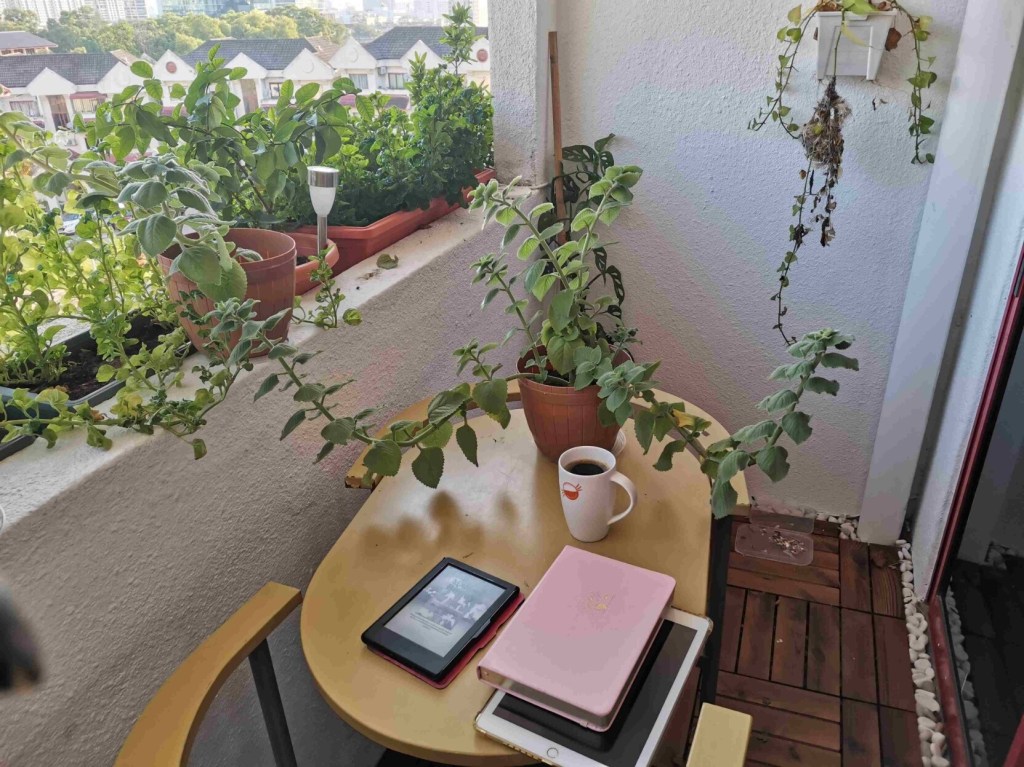
I was thinking of walking to the nearest cafe to read blogs and journal but realize I have a perfectly good spot in my apartment to do that. If you have been following my BalconyNest posts, the nest is at the upper right corner of the pic, hanging from the plant.
I ❤ my apartment.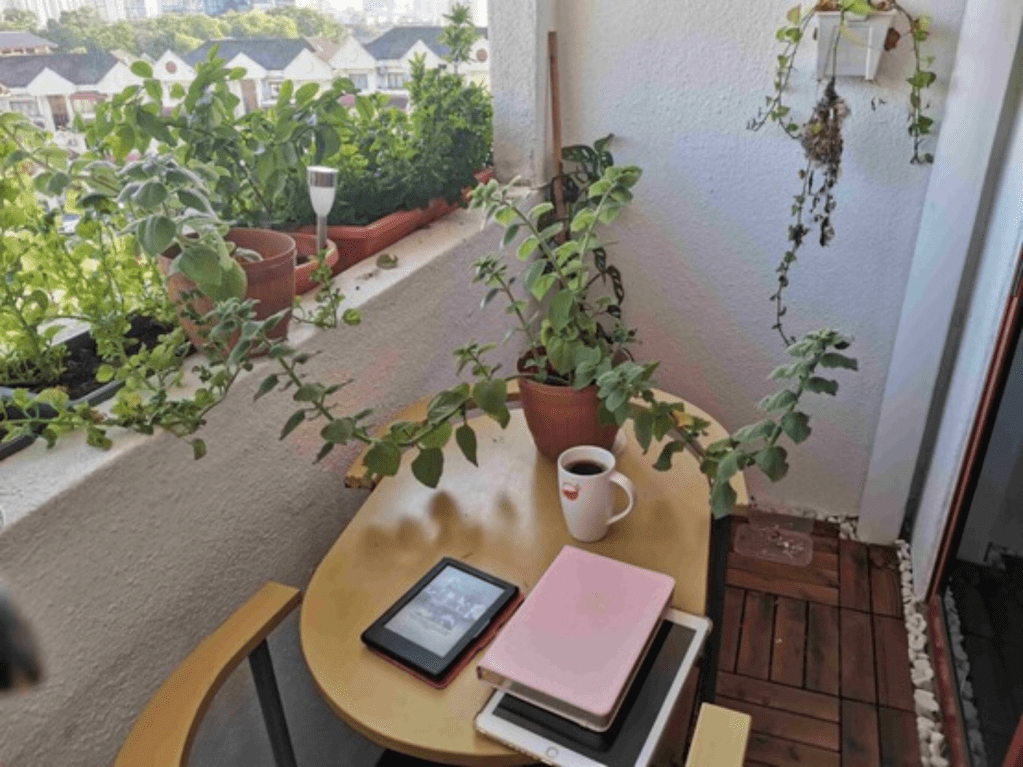
Feb 19, 2023
Now that the sunbirds are grown up, they leave around 7am to go on their bird adventures all day and return around 6pm for bed time.I had a good look at the nest today and was amused and quite impressed that it is made up of rafia string, twigs, dried leaves and…fur! What dog or cat contributed to this nest, I wonder?

Feb 19, 2023
The wee little sunbird chick returns to the nest for the night. Where you been all day, little bird?April 23, 2023
I just spotted two sunbirds fiddling with the old nest. They have been at it quite a bit! Are we going to see another batch of chicks??Are these the same pair? The babies? So excited.
Nov 17, 2023
Saw a little sunbird perch on the remnants of the nest again. I keep hoping for them to return, because I really loved watching the chicks grow up and fly out of the nest. 🙂 May I be blessed in the future!
2025 the sunbirds return! I start a new journal observing them.
-
The vigil at the manor (Part 3/7)

Subscribe to continue reading
Subscribe to get access to the rest of this post and other subscriber-only content.
-
Subscribe
Subscribed
Have a WordPress.com account? Log in now.

