-
I love Malaysia. I also resent it.

Photo by Ishan @seefromthesky I like watching videos of tourists making videos of their trips to Kuala Lumpur. Apparently, it’s a very Malaysian thing to watch these videos. Some say it’s down to our insecurity as Malaysians, we just like to be reassured that we’re awesome, and these foreigners most assuredly would say something nice and complimentary about Malaysia. For me, I probably have a bit of the latter and also this: I’ve been down and negative about Malaysia all my life, and it’s nice to be reminded about the good things we have in the country.
While a lot of Americans believe in the exceptional qualities about their country, a large number of Malaysians, especially non-Malaysians, view Malaysia in a negative, almost inferior light.

Subscribe to continue reading
Subscribe to get access to the rest of this post and other subscriber-only content.
-
5 more reads from Asia

How difficult is it to find unique voices from Asians who hail from Asia? Especially on Substack? How about bloody difficult? Well, fortunately I’ve done the work for you.
My last issue highlighting unique, but barely talked about newsletters from Asia was quite popular, so I thought I’d unearth five more finds from Asia for you.
You’re probably wondering why I’m so fussy about my selection, why Asians from Asia? How about Asian Americans etc? Well, the English-speaking world is inundated by content from Western perspectives, ideals, and values. Yes, even Asian Americans voices and perspectives are shared more often in the English-speaking space.
But South-East Asian voices? South Asian? East Asian? Well, as most write in their native tongues, or usually do not dwell in Western-dominated Substack, you will hardly find them here.
I want to highlight them so that you can get insights into different perspectives. So here are some of them:
Khải Đơn by Khải Đơn (Vietnam)
Poetry and essays. Yes, she does write a lot in Vietnamese. So if you happen to be learning Vietnamese, congratulations! Comprehensive input right there. Still, she has an English Writing category. Favourite essay: The Man Running from the Death.
Words for Worlds by Gautam Bhatia (India)
Gautam shares his love for science fiction. One of the pleasures of his newsletter is that I get to know about Indian sci-fi authors and authors I’ve not heard about. (BTW I’m so jealous of India’s writing scene!) His selection in Issue 76 is very fascinating as he highlights books from the Middle East.
72 Seasons of Tea by Peck Gee Chua (Malaysia)
Malaysia-born, Kyoto dweller. Found out that she’s a fan of Kishore Mahbubani in her newsletter Idealist x Realist. Anyone who knows about and understands Kishore’s words is worth a lot of reads ;P
Conscious Living by Rachel Ooi (Malaysia)
Can I cheat by including another Malaysian? I appreciate Rachel’s comments when I drop my newsletter, each and every time. 😉 I really relate to her essay, What success truly means. Her essays are a soothing read for the weekend.
China Translated by Robert Wu (China)
You’ve probably heard me rave about Robert a few times in my newsletter. But just in case you missed it, here is he, mentioned again. The essay that made me notice him was his series of essays on Noah Smith, namely, Will China squander its moment in the sun? and Noah Smith is clueless about China. At that time, Noah was driving me insane with his misinterpretation and falsehoods about China, and it was vindicating to read someone who agrees with me LOL. Want a nuanced view of China? Read Robert’s newsletter.
Well, I still have a lot more newsletters from Asian voices in my feeds, so look forward to more in the future. Meanwhile, if you know Asian voices from Asia, drop a comment below!
Thank you for reading Tai Tales! To receive new posts and support my work, consider becoming a free subscriber.
As I know subscribing to a newsletter can be quite a commitment, you can also give me a tip:
If you liked this issue, it would be great if you could share it with your network. 🙂
-
Malaysians stunned by Kuala Lumpur sinkhole
A few days ago, news broke out that made me really suspicious of the ground beneath my feet.
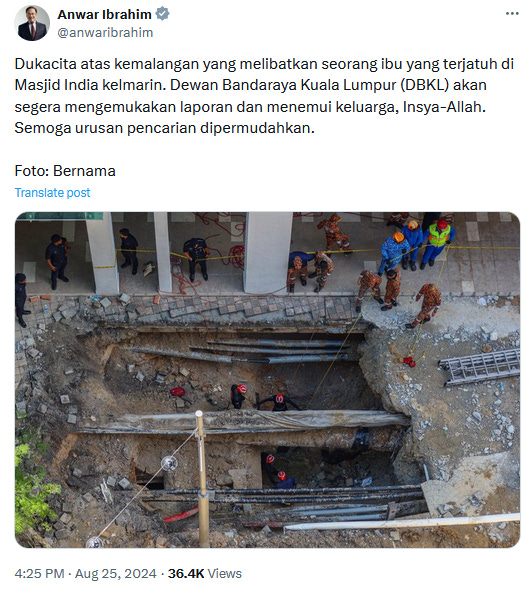
A tourist from India was walking around in the popular tourist area of Masjid India when a sinkhole appeared beneath her. She fell into it.
ℹ️ Jalan Masjid India is a popular tourist spot located near Masjid Jamek, a hisotorical landmark. It is an enclave for the local Indian community and has a famous night market.
I remember reading the news and thinking, poor thing. I hope she didn’t break any bones.
And forgot about it.
The next day, I discovered that they could not find her. She had completely disappeared and only her slippers were found.
My brain immediately went: How in the world can someone disappear when falling into an 8m-deep hole??
But it turns out that there was fast-running water in the hole and she was swept away.
One theory is that her body was swept away into the maze of sewage pipes beneath the city. An expert even said that authorities should call off the search because: “These sewer lines have a minimum flow speed of 1m per second. Theoretically, the body could have travelled up to 86.4km within 24 hours.”
To make matters worse, a second sinkhole appeared in the same area a few days after, so now the raod will be closed. The much-awaited Merdeka parade for Malaysia’s national day is also cancelled due to this, out of respect for the victim. (The parade takes place quite close to the area.)
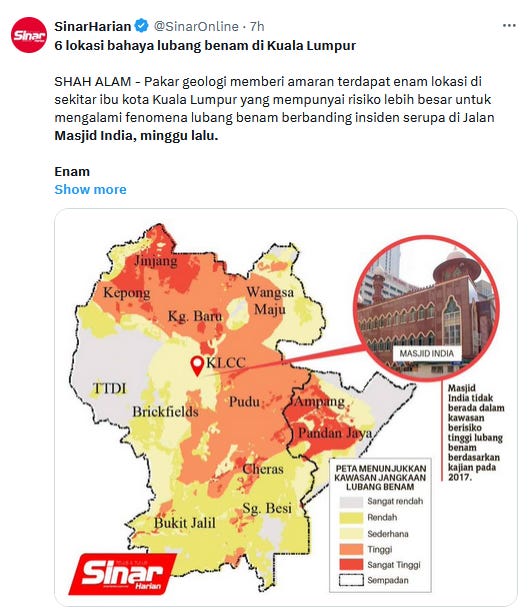
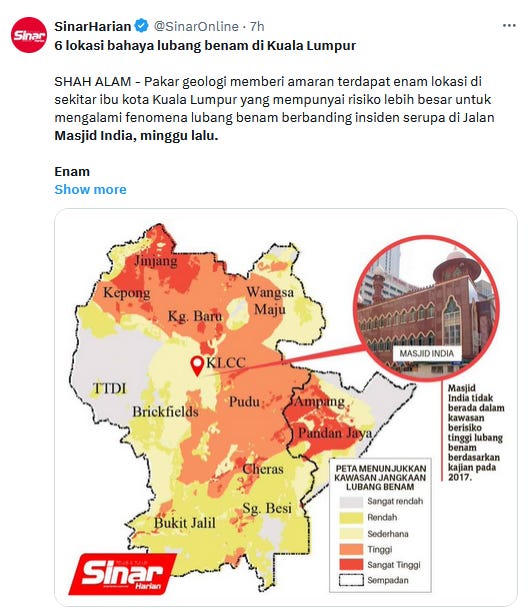
Helpfully, or perhaps unhelpfully, a Malay daily released this map which highlighted sinkhole “danger zones” in Selangor.
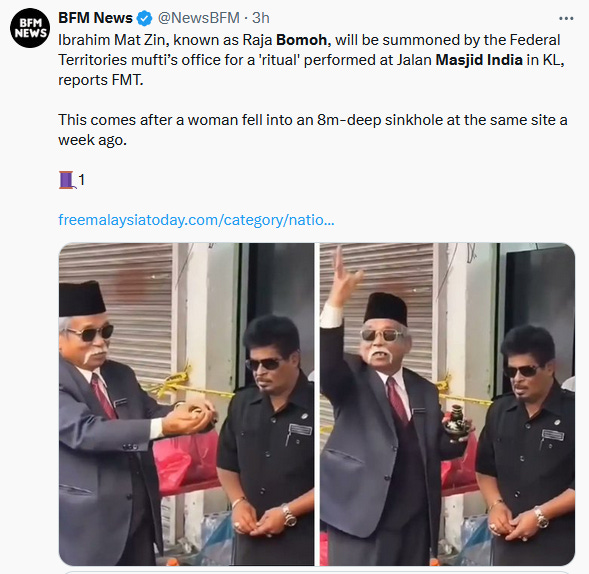
Adding to the chaos, a local “bomoh” (witch doctor) is performing rituals at the area. He is a semi-celebrity of sorts, having gained infamy when he performed a ritual in the Kuala Lumpur International Airport after MH370 going missing broke out.
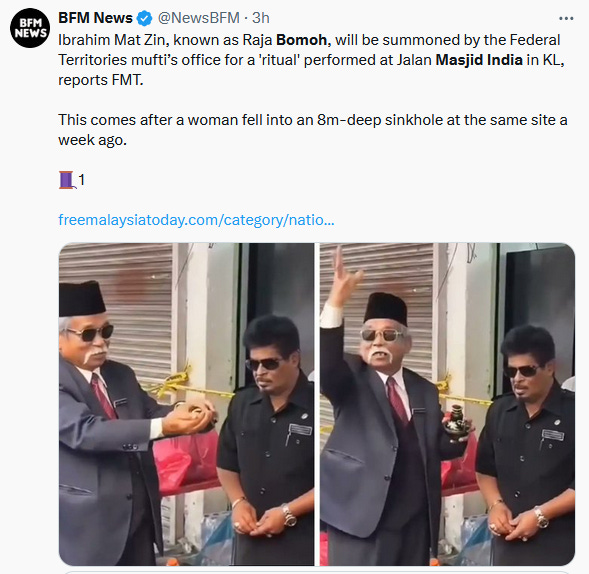
Personally, I think this is a tasteless attention grab and maybe that’s why the religious authorities are not amused and have summoned the bomoh for questioning.
A healthier and more respectful ceremony by local Indian groups took place near the site, fortunately.
And the prime minister also expressed his condolences to the victim’s family.

A lot of Malaysians seem to believe that the sinkhole is the result of negligence. Perhaps, but the scarier story is that it is also a natural phenomenon. Massive sinkholes have appeared around the world, as this video below demonstrates.
In fact, a sinkhole appeared in Seoul yesterday.
Malaysia rarely gets natural disasters, so when something like this happens, it is literally earth shaking.
I pray for the victim’s family, and I hope that she will be found, somehow.
Thank you for reading Tai Tales! To receive new posts and support my work, consider becoming a subscriber.
As I know subscribing to a newsletter can be quite a commitment, you can also give me a tip:
If you liked this issue, it would be great if you could share it with your network. 🙂
-
That time when I lived in a haunted house

Casually over dinner, like he was talking about an item on a shopping list, my Dad said: “Eh. You know? I think that house we lived in was haunted.”
The family paused just for a few seconds.
And just as casually, we said, “Yeah, we know.”
And one by one, we shared our ghostly encounters in that house numbered 14.
Subscribe to continue reading
Subscribe to get access to the rest of this post and other subscriber-only content.
-
The circle of competence and our information diet

This is a follow up article to Auditing my social media use and information consumption.
“Organise your professional life rigorously around your circle of competence. This radical focus will bear more than monetary fruits. Above all you’ll save time, because you won’t keep having to decide where to direct your attention. Knowing your circle of competence is your tool, your scalpel, enabling you to divide sources of information into what’s valuable and what’s not.”
— Rolf Dobelli – Stop Reading the NewsI’ve been thinking about this quote more and more these days. If you’ve not heard about the concept of “the circle of competence” below is a good video about it.
I have been thinking about this for a long time. I wrote about the need to be mindful of our information diet. When I got mentally exhausted by Olympics drama on social media, I decided to audit my social media use and realise that I spend a lot of my time – too much of my time – focusing on things outside my circle of competence.
Is this a good use of my time?
NO.
I created this chart to visualize what content would fit in the circles. The ones in purple basically shows how much focus I give on the content. Meaning, I spend a lion’s share of my time on social media browsing and consuming this content.

At first, I wanted to add to each level whether it “benefits my work” or not, but I think that’s not as helpful as “I can control”. So, the red circle represents what I know and can control, but the green circles represent subjects that I cannot control.
Therefore, it makes more sense to focus on the subjects in the red circle as it’ll bring the most benefit to me in my life.
You are probably wondering why I placed “Chinese dramas” in the red circle, but I think it could actually bring me some financial benefits one day if I ever want to monetise the content I’m putting out. (Maybe in my retirement years!)
Currently, it does help me learn Mandarin, so you can say that Chinese dramas will indirectly help me in that goal, and increasing my proficiency in the language will definitely help improve my marketability.
Also, it’s damn fun and totally improving my mental health.
Not sure about the part about managing a 68k Reddit Chinese drama sub though LOL.
This circle is a sobering indictment that I’ve been misplacing my focus when it comes to information consumption. Geopolitics is, unfortunately, at a primal level, entertaining. The content around geopolitics is meant to push our tribal buttons. Worse, not only do I consume geopolitical content, I also release some content about it due to this overpowering curiosity, but I don’t think I’m benefiting anyone.
Also, after writing the little journal entry about my attempt to find out more about the British riots, I have to come to the sad conclusion that I’ll never, ever, ever find out the 100% truth about an event because truth is relative especially in the cruel world of geopolitics.
Also, let’s face it, I’m not an expert. People like Kishore Mahbubani and George Yeo can certainly call themselves that because they were actual government officials that worked in the diplomatic circles.
I, on the other hand, is nothing more than a glorified amateur researcher and consumer of too much Youtube videos on geopolitics.
Sure, I could tell people what I stand for, but how does that help anything beyond making me feel good about myself and signal to others what a virtuous person I am (or devil, depending on what political side they’re on).
On top of all this, political discourse in the Internet and social media age is abysmally broken. It destroys relationships and societies more than it builds. Worse, it could cause political violence.
Do I really want to be exposed and to be part of this unproductive and destructive cycle?
But I must confess, geopolitical news is addictive! I guess there’s something in our brains that craved the idea of being “our side winning” or maybe we just like being scared to death about World War III constantly.
However, all this attention on a topic that is out of our circle of competence is hours taken away from subjects that could actually improve your life, such as studying about improving your health and self care, becoming an expert and influencer in your field and managing your finances better and finally getting debt free.
If there’s one time that I did the whole information consumption right, was that period when I hyperfocused on personal finance content, career optimization and minimalism.
All these topics helped me pay off all my debts, including my mortgage, become debt free, live in a way that I enjoyed and choose the career that aligned with my values.
I now live the life I want.
So, it’s time to go back to that.
-
What’s happening in Britain?
Trying to get a balanced view from mainstream media was challenging.
My “bad take” sensors were immediately on the alert when the words “far right” was just thrown around casually by the mainstream media. “Othering” the other side is a very fast and unfortunately, efficient way, of drowning out contrary narratives, so I quickly moved on from the mainstream media to other sources of media.
Asking social media what is happening in Britain, especially on left leaning Mastodon, was probably not the mentally safest way to do so. I doubted that I’d get a nuanced view, and I knew I’d be exposing myself to some outrage for daring to even ask or have an opinion about the situation, but I really wanted to know what folks in Britain were thinking about the riots in the UK.
I got interesting perspectives which helped me evaluate what the voices from the left leaning crowd were saying.
Then I moved on to Youtube.
I know, I know. This is not the best place ever lol.
Oddly, or maybe not oddly, Youtube kept recommending me vitrolic, anti-immigrant rants. Huh.
So, I gravitated towards long conversations between academicians rather than quick, dramatic outrage videos that are so de rigour among political pundits. I also try to get a more global perspective: Europe, Asia, Africa, for example.
Some recommendations
Here are some that I thought were a good listen, which offered a bit of nuance:
“Everyone is far right all of a sudden … the average person who has no political affiliation, no extremist views just want to be heard. They can’t be heard because they’re being labelled as far right. … You’re not allowing people to actually have a conversation.”
“The rest of the world knows England in a way that it doesn’t itself.”
My thoughts: If you have time to only listen to one, watch this. One of the issues they talk about is how they highlight the fact that the higher classes are sniffing at the lower classes who often are hobbled by their poorer quality of education, which impacts their critical thinking skills. Frankly much of the ills of a country, and this includes Malaysia, is the growing divide between the upper and lower classes. The governing elites (and this includes media personnel), are often from the upper classes due to their better access to education and opportunities, but due to this disconnect, policies are often not made for the people of the lower classes, whom they have no connection or relations with.
“Failing to give people a sense of purpose and direction … (the government) doesn’t seem to be interested in governing but just responding to events. In an economic crisis situation, the pressure cooker is becoming much greater. … It’s outside the normal pattern of usual summer riots that we fairly see regularly in Britain.”It’s kinda sad that people have to go through all this effort to understand what’s going on in the news.
However, I do wonder if all my effort was necessary as that’s a lot of time spent contribute to an area outside my circle of competence.
-
The reason why you’re so tired at work: Context switching
I love Cal Newport’s advice in general. For example, this video gave me an aha moment which made me realise why I’m so gosh darn mentally exhausted at the end of a work day.
I was context switching all day, and having work chat on (for eg slack) beside me all the time was literally doing my brains in. (And that constant desire to look at my damn phone… I feel like I may have to exile my phone from the home office from now on.)
But then, I feel like I couldn’t really apply his advice. Working in uninterrupted stretches of time is nigh impossible at some workplaces. For me to do so, I’d have to start work either much earlier than 9am or after 6pm, when everyone has clocked off.
During intense periods of times, I often do that, which doesn’t do well for me because I’m often expected to be “on” until 6pm, which means I could easily work up to 12 hours as a result.
Besides that, there’s also the way the project management software, Jira, is set up. I love Jira most of the time – it keeps teams accountable and helps us track our workload. Rather than an amorphous blob, my tasks are represented by tickets, and the project manager can easily see if someone is overloaded by seeing the number tickets someone is dealing with.
However, due to the fact that work is broken down into so many tickets, and discussions around work can still take place outside those Jira tickets in disparate places such as chats, meetings and more, one can’t help but bounce from one context to another in a frantic blur.
However, even Cal admits that his advice isn’t perfect, but “at least we know what’s the source of the problem so you can do something about it.” (Paraphrased).
So I’m pondering on how I can be managing my Jira tickets better.
I’m contemplating a few strategies (based on Cal’s advice). Say I have a task to update Product A’s documentation:
- Work on the doc, shut off all comms channels for an hour. Update Jira tickets once completed. (Context-specific task focus)
- Day-specific tasks. For eg, some days are full of meetings, which makes it challenging to get working on focus-specific tasks. So, to work on meeting-related work on that day only (such as writing reports) and have specific days to work on docs. (I know this is a luxury though, and most probably not possible).
- Work on focus-specific, writing-heavy tasks in the morning, more Jira/update docs in the afternoon.
-
Weekend Tales #6: The Paris Olympics fried my brain
If there’s a range when it comes to social media endurance, I’m probably at the low, low end. Like, the weakling end.
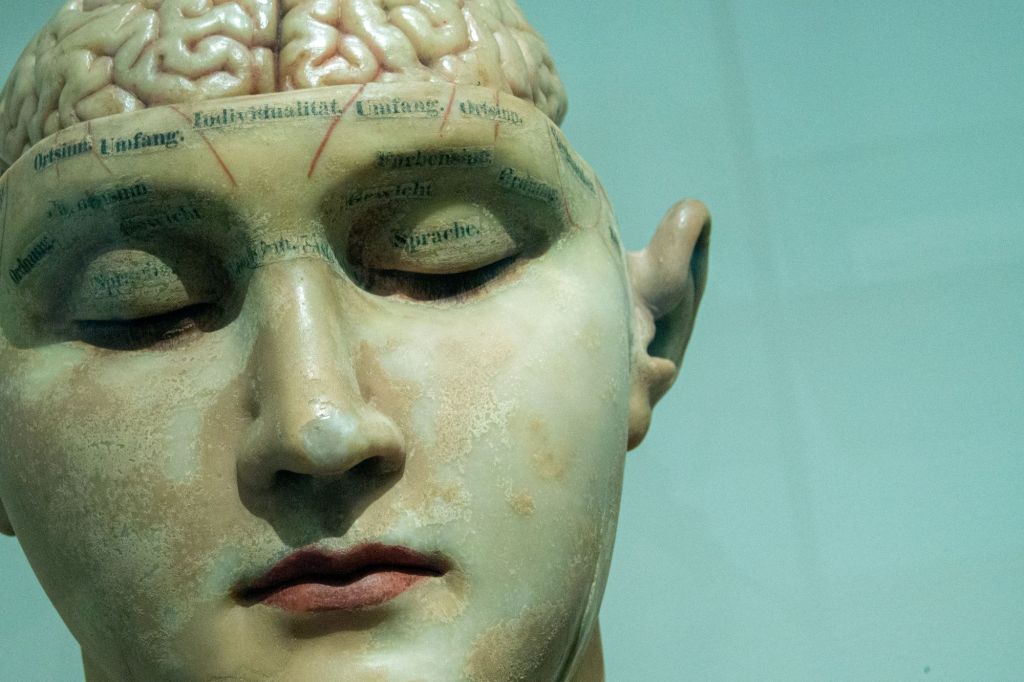
I have a natural tripwire; when my brain has had enough of the chaos and noise of social media, it just nopes out, and when it does, it nopes out hard whether I like it or not. During these periods, I worry about losing friendships because I become this intense digital hermit. Because these periods can last for weeks.
However, for some reason, this week, my natural tripwire did not trip. I found myself totally entranced by the Paris Olympics, and not in a good way. Specifically, the ghastly opening ceremony that many Christians around the world regard as blasphemous.
Subscribe to continue reading
Subscribe to get access to the rest of this post and other subscriber-only content.
-
Learning Chinese vocabulary as a headless chicken

Not gonna lie, when I read Victoria’s Study Notepad: Language studies or Magda’s Mandarin Weekly, I feel like a total slacker.
I have a vague-ish study plan somewhere in my noggin’, but there’s no way I can get organised enough to do pie charts, or count the number of hours I spend learning Chinese.
For one, Excel makes my head explode and I am already dealing with spreadsheets at work, and don’t really want to do it after work, thank you.
Yet, I totally understand the value of tracking stuff, so I’m glad that Tofu Learn at least has some stats thingy that I can keep track of.
My main learning goal for Chinese is to read as soon as possible, so my language learning activities are geared towards that.
Subscribe to continue reading
Subscribe to get access to the rest of this post and other subscriber-only content.

-
Subscribe
Subscribed
Have a WordPress.com account? Log in now.

